Candidate for new UN Secretary General outlines campaign of “reform and strengthening”
Nominated by Mexico and Brazil, former Chile President Michelle Bachelet seeks UN role, pledging “results for the people we serve.”

United Nations, New York City
Sphinx News: Ahmed Ali
Emerging as a candidate for the soon-vacant position of United Nations Secretary-General, former Chile President Michelle Bachelet is a frontrunner, pitching “strength and reform” to address the world’s current propensity for conflict.
Described as a pioneering Chilean politician, known for being the country’s first female head of state, Michelle Bachelet served in Chile’s socialist party, President of the Country from 2006–2010, and 2014–2018. Also the state’s first female defense minister in 2002, Bachelet focused her presidency on social reform, health access, and gender parity, a political agenda massively shaped by her difficult upbringing.
In 1973, Bachelet’s father was arrested for opposing the military coup that brought longstanding Chilean ruler Augusto Pinochet to power. Tortured in custody, Bachelet’s father eventually passed away while in custody, paving the way for her and her mother’s arrest in 1974. In 1975, Bachelet was released into exile, furthering her career in medical studies and politics in both Australia and East Germany.
Additionally, Bachelet would serve as the United Nations High Commissioner for Human Rights from September 1, 2018, to August 31, 2022, known for her expertise in modifying preexisting human rights mechanisms, one more capable of fighting discrimination and protecting vulnerable civilian populations.
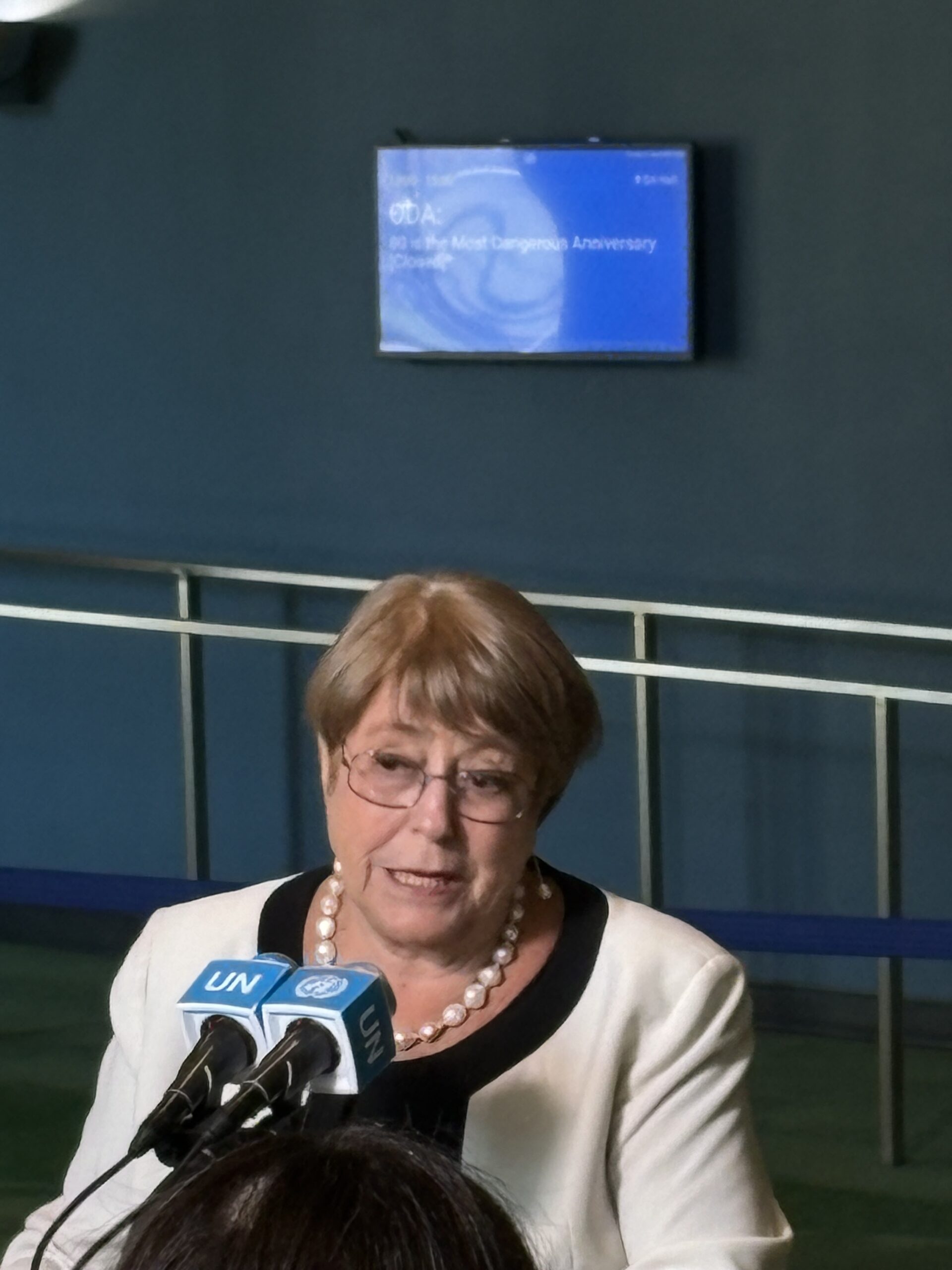
Answering, earlier today, the questions posed by member states in an informal dialogue inside the Trusteeship Council, Bachelet would later speak to members of the press at the General Assembly Stakeout, staunch in her commitment to amend the UN’s current apparatus and make it “more fit for purpose.”
In her comments, Bachelet told media outlets, “the world needs a United Nations that upholds the principles and purposes enshrined in the United Nations Charter.”
With her candidacy shaped by an agenda of “strengthening” existing organizations and “reforming” others, clear in her subtle vindication of the existing apparatus was its “fit for purpose”, noting that the United Nations is experiencing a time of great peril and global dangers, operating in a “not so easy world.”
Highlighting the job title’s massive responsibility, evident through the lack of available candidates, Bachelet told the press that her campaign is characterized by “conviction”, facilitating uncomfortable discussions through dialogue and compromise.
Critical to her objectives are mitigating differences, finding ways to “produce similarities and work with differences.”
Inspired by the tireless efforts of peace by South African revolutionary, Nelson Mandela, Bachelet speaks of a leadership where Mandela “understood the bigger picture”, using dialogue and diplomacy to triumph over violence, and where international law can supersede impunity. The world, as Bachelet envisions it, can only be reconciled through a conscious effort aimed at “ensuring the dignity of all human kind”, a notion reaffirmed in her later statement where she told members of the press that she is “a firm supporter of women’s rights.” She added, “I will always be on the side of women, upholding opportunities that respect their dignity and self-determination.
While Bachelet upholds such clear values, she noted that her responsibility lies not in personal agendas, but upholding global consensus, referring to her dedication towards implementing The 1995 Fourth World Conference on Women, held in Beijing, China.
On her credentials to lead the organization into a more sustainable and relevant future, Bachelet emphasized her role as previous President of Chile, “in charge of a country with 20 million people… transitioning away from a dictatorship and into a democracy.”
Channeling such ability to mobilize people around a common cause will be critical if Bachelet were to be elected. As the United Nations faces a crisis around its practicality, a contention which has massively inhibited the organization’s financial acumen, many not only question the UN’s relevance, but also the purported naivety of its mandate, whether it is able to function in a moment of great polarization. Strong leadership, for that very reason, will be essential to guiding the UN away from international insularity, proving to people and member states that the organization CAN adapt in a way that is both meaningful and effective.