Russian Diplomat Criticizes E3 Sanctions Move, Says West Abandons Diplomacy
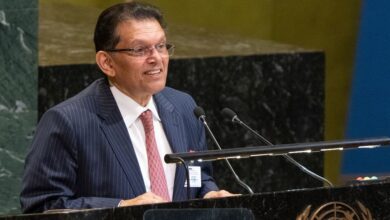
Ambassador Dmitry Polyanskiy, Chargé d’affaires of the Russian Federation to the United Nations strongly condemns E3 snapback mechanism on Security Council Resolution 2231.


United Nations
Sphinx News: Ahmed Ali
Ambassador Dmitry Polyanskiy, Chargé d’affaires of the Russian Federation to the United Nations, stated, “Western states do not know diplomacy.” The strong rhetoric from the Russian diplomat follows a move by the E3—France, the United Kingdom, and Germany—to implement the snapback mechanism under Security Council Resolution 2231, adopted in 2015.
Resolution 2231 endorsed the Joint Comprehensive Plan of Action (JCPOA), marking a significant shift in the international approach to Iran’s nuclear program. The JCPOA, adopted on July 14, 2015, by China, France, Germany, the Russian Federation, the United Kingdom, the United States, the High Representative of the European Union (E3/EU+3), and the Islamic Republic of Iran, reaffirmed economic sanctions relief to Iran in exchange for the Islamic Republic’s nuclear limitations.
On October 18 of this year, the resolution is set to expire, with the E3 members opting not to renew it. Instead, they have activated the snapback mechanism, a clause allowing sanctions to be quickly reimposed if Iran is found to violate the agreement. The E3’s decision was officially announced today, with the French, German, and UK foreign ministers issuing a joint letter to the Security Council stating: “Since 2019 and as of today, Iran has increasingly and deliberately ceased performing its JCPOA commitments.” The letter added, “This includes the accumulation of a highly enriched uranium stockpile, which lacks any credible civilian justification and is unprecedented for a state without a nuclear weapons program.”
Russia and China have since responded with a draft resolution at the Security Council. Announced by Ambassador Polyanskiy, the draft calls for “an extension of Resolution 2231 for six months until April 18, 2026, with the possibility for further extension and urges all JCPOA participants to resume negotiations.”
Alongside proposals for this draft resolution, which Polyanskiy frames as a step toward diplomacy and the preservation of international peace and security, the ambassador criticized the E3’s use of the snapback mechanism. He stated, “Western countries do not care about diplomacy; they only care about blackmail, threats, and coercion of independent countries.”
Polyanskiy argued that the E3’s decision “has no legal basis,” noting that the IAEA found no evidence of a nuclear weapons program in Iran. “We did not have any proof of a systematic effort to move into a nuclear weapon,” IAEA Director General Rafael Grossi said in a statement released on June 18. Polyanskiy added that since the United States withdrew from the JCPOA in 2018, “the situation has deteriorated,” ultimately prompting the E3 to adopt such measures.