Republic of Korea, President of the Security Council for the month of September
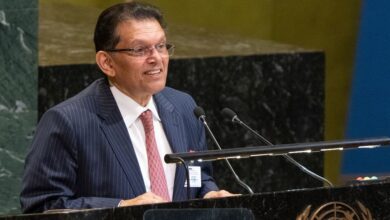
Ambassador Sangjin Kim, Chargé d’Affaires of the Republic of Korea to the United Nations and President of the Security Council for September, briefed the press on the Council’s program of work, the E3 snapback, Gaza, and the 80th UN General Assembly.


United Nations
Sphinx News: Ahmed Ali
Ambassador Sangjin Kim, Chargé d’Affaires of the Republic of Korea to the United Nations and President of the Security Council for the month of September, held an in-person press briefing on Monday. Widely considered one of the busiest months at the United Nations, Ambassador Kim outlined the Council’s program of work, addressed the E3 snapback mechanism, weighed in on the Palestinian question, and discussed the role of artificial intelligence may play in the future of geopolitics.
Reflecting on Korea’s own history, Ambassador Kim noted, “Korea rose from the ashes of war to receive massive common good,” stressing his country’s awareness of its global responsibilities. He emphasized that Korea intends to “fulfill its responsibility to the presidency” by working to build consensus and serve as a bridge for diplomatic dialogue within the Council.
On the contentious Iranian nuclear issue and Security Council Resolution 2231, Ambassador Kim declined to state Korea’s formal interpretation, saying, “We have our own interpretations, but right now is not the time to share those interpretations within a presidential and national capacity.” Instead, he highlighted the Council’s divisions, acknowledging that “different interpretations” exist but insisting that Korea would help foster effective diplomatic conversations.
While no specific date has been set for a vote on the draft resolution put forward by Russia and China regarding the JCPOA, he signaled that member states are nearing a diplomatic breakthrough, adding, “We are aware of our role.”
On the Middle East, Ambassador Kim acknowledges that the Council remains “paralyzed” over the ongoing conflict in Gaza and the question of sanctions on Israel. He reaffirmed Korea’s support for a comprehensive two-state solution, but clarified that Korea does not intend to recognize the State of Palestine at the upcoming UNGA 80th Assembly. “Korea does support a two-state solution,” he said, while stressing that recognition is not on the agenda.
Turning to emerging global challenges, Ambassador Kim noted Korea’s decision to convene a high-level meeting on artificial intelligence during its presidency. He underscored both the opportunities and risks posed by new technologies, remarking that “human beings are the ones who run development, not AI.”