UNGA 80: World Leaders Back Two-State Solution, Condemn Israeli Actions at High-Level Peace Conference
Ahead of the UN’s 80th anniversary High-Level Week, France and Saudi Arabia co-chaired a conference where world leaders reaffirmed support for a two-state solution and condemned Israeli actions in Gaza and the West Bank.


United Nations
Sphinx News: Ahmed Ali
Chaired by France and co-chaired by Saudi Arabia, world leaders gathered at the United Nations to confront what French President Emmanuel Macron called “the massacre of Gaza.”
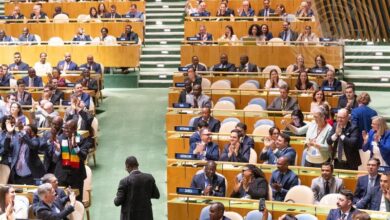
At the General Assembly Hall in New York, heads of state, foreign ministers, and high-level delegations joined in solidarity with the Palestinian cause. The conference, convened to discuss the imminent two-state solution and the plight of Palestinians, opened with Macron setting a tone of urgency. “We are here because the time has come,” he declared.
“Nothing justifies the continuation of the war in Gaza. Nothing. Everything compels us to put an end to it—now. To save lives. Israeli hostages, Palestinian civilians, all lives. A life is worth a life,” Macron said, emphasizing that the United Nations’ work remains unfinished. “In 1947, this Assembly decided to partition Mandatory Palestine into two States, one Jewish and one Arab. The promise of a Jewish state was fulfilled; the promise of an Arab state remains unfinished to this day.”
Egyptian Prime Minister Mostafa Madbouly, speaking on behalf of Cairo, dominated the discussion with a detailed roadmap. “Without a just solution, there can be no stability in the Middle East,” he said. “The two-state solution is not merely a political option—it is a security necessity.” Madbouly condemned Israel’s military aggression and the humanitarian toll in Gaza. “Ignoring Palestinian rights brings only instability. The absence of a political horizon opens the door to more violence, as recent developments have painfully shown.”
Madbouly outlined Egypt’s concrete steps: hosting an international conference to fund Gaza’s reconstruction, ensuring that aid reaches civilians unhindered, and helping Palestinians rebuild governance under a unified administration. “Our aim is a sovereign, independent Palestinian state with East Jerusalem as its capital,” he said.
Turkey’s President Recep Tayyip Erdoğan underscored the human toll. “Since October 7th, over 65,000 Palestinians—mostly women and children—have lost their lives, and more than 165,000 have been injured. No one with a conscience can accept this genocide.” Erdoğan called for an immediate ceasefire, unrestricted humanitarian aid, and Israel’s withdrawal from Gaza. “Gaza is an inseparable part of Palestine and belongs to the Palestinian people,” he stressed.
Palestinian Authority President Mahmoud Abbas demanded full UN membership for Palestine. “The Palestinian people will not accept to live as second-class citizens under occupation,” he said, calling for a unified, law-abiding Palestinian government and internationally supervised elections.
Saudi Arabia, represented by Prince Faisal bin Farhan Al Saud, reaffirmed Riyadh’s commitment to a peaceful resolution. “The implementation of the two-state solution is the only path to justice and security in the region,” he said, urging other countries to recognize Palestine and support a durable peace.
By the conference’s end, 153 member states had formally recognized Palestine, sending a unified message: the two-state solution is essential, Gaza’s suffering must end, and justice for the Palestinian people is the foundation of lasting peace.