Russian Ambassador says Russia ‘does not recognize’ E3 snapback on Iran
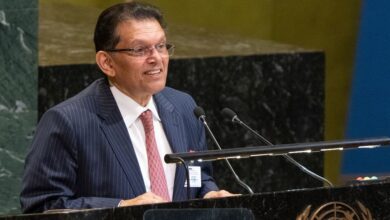
As Russia’s UN Ambassador and October Security Council President, Vassily Nebenzia briefs the press on the 'diplomatic validity' of Iran snapback sanctions, rejecting the E3 move as lacking legal basis and claiming the U.S. is "calling the shots".


United Nations
Sphinx News: Ahmed Ali
In anticipation of his Presidency of the Security Council for October, Russia’s Permanent Representative to the United Nations, Vassily Nebenzia, denounced the “so-called snapback” mechanism on Iran as illegitimate. He asserted that Russia does not recognize what he described as an “illegal” measure, adding that its use by the E3 constitutes a “serial violation of Resolution 2231.”
Security Council Resolution 2231 endorsed the JCPOA, a framework negotiated a decade ago under the supervision of the E3, the P5, and Iran. It allowed sanctions relief for the Islamic Republic in exchange for compliance with nuclear restrictions. The agreement, set to expire on October 18 this year, has faced increasing tension in recent months. France, Germany, and the United Kingdom unanimously invoked the “snapback mechanism,” a clause enabling states to reimpose sanctions if they believe Iran is not fulfilling its JCPOA obligations.
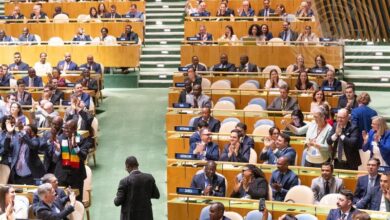
The move has drawn strong criticism from China, Russia, and Iran, all of whom describe it as a “blatant betrayal of diplomacy.” Iranian Foreign Minister Seyed Abbas Araghchi told the Security Council on Friday September 26th, that the measure lacks legal justification and is aimed at subverting Iran. He pointed out that Iran had recently reached an agreement with the IAEA to allow full inspections of its nuclear program. Iranian President Masoud Pezeshkian reiterated this position at the General Assembly the same day, declaring that, “Iran has no intention of developing nuclear weapons”, as such a move would be in direct contravention to the country’s religious and moral principles.
Despite these assurances, a draft resolution backed by Russia and China to extend the JCPOA for another six months—intended to allow more time for a diplomatic solution—failed in the Council. Following the vote, Russian Deputy Permanent Representative Dmitry Polyanskiy stated: “Now, there certainly are no longer any illusions. These countries have definitively demonstrated that all of their assurances about their focus on arriving at a diplomatic resolution to the Iranian nuclear program issue for all of these years were mere noise.”
Speaking to the press today, Nebenzia echoed this sentiment. “Russia does not recognize this illegal implementation of snapback on Iran,” he said. Questioning the decision’s legitimacy, he argued that Western states “have repeatedly said they are open to diplomatic solutions, even though they have forfeited diplomacy already” by pursuing what he called “an illegal procedure.” The Russian-Chinese draft resolution, he stressed, was “an attempt to give diplomacy a chance”—one rejected by the Council.
Nebenzia further revealed that Russia had warned Secretary-General António Guterres “not to rush with the reimplementation of snapback,” adding: “We are not happy that the SG rushed to implement the resolution, which has obvious legal flaws.”
For Nebenzia and Russia, “snapback did not happen.” He insisted the E3’s decision was driven by U.S. pressure, noting Washington’s withdrawal from the JCPOA in 2018. As he put it: “The U.S. is calling the shots.”