Danon reiterates strong threats to Hamas ahead of Security Council clash
Israeli Ambassador Danny Danon briefs the press ahead of a contentious UN Security Council debate on the Middle East, urging full Hamas disarmament and the release of hostages. The U.S. echoed and brought forward additional concerns over Iranian influence, while the Palestinian Observer Mission welcomed the peace deal but stressed the need for dignity and rights for Palestinians.

United Nations
Sphinx News: Ahmed Ali
New York City, NY- Ahead of the 10,023rd meeting of the Security Council, convened under the agenda item on the Palestinian question, Israeli Ambassador Danny Danon delivered a forceful statement outlining Israel’s position. Danon emphasized that no peace or reconstruction in Gaza can move forward “as long as Hamas remains in violation of its agreements under the peace deal.”
The Permanent Representative welcomed the Gaza Peace Deal brokered by U.S. President Donald Trump, with the support of Egypt, Qatar, and Turkey, describing it as a “historic moment” that marks “the return of all living Israeli hostages.”
“After years of violence,” Danon said, “Hamas has been forced to accept a deal that ensures the release of all remaining hostages and full disarmament.” Despite this achievement, he cautioned that “the fight is not over,” pointing to a chart displaying 13 hostages still unaccounted for. “We will not rest until every one of them is brought home,” he added.
With the Council set to deliberate on the Palestinian question, Danon asserted that “terror continues,” identifying Hamas as the main perpetrator. “The terror group,” he declared, “is emerging from tunnels, turning its weapons against its own people, and executing men like ISIS.”
Danon also expressed strong condemnation of what he described as the United Nations’ silence on ongoing Hamas activity, stating, “From the UN—nothing. No condemnation. No emergency session of the Security Council. Just silence that empowers Hamas.”
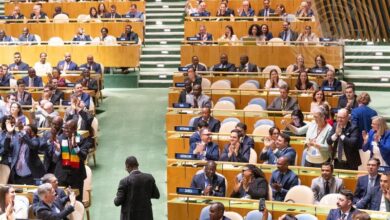
Security Council 10,023rd meeting
Mr. Ramiz Alakbarov, Deputy Special Coordinator for the Middle East Peace Process, United Nations Resident and Humanitarian Coordinator, commended the “remarkable diplomatic effort by the United States, Turkey, Egypt, and Qatar,” calling the agreement a step toward “a better future,” while warning that it “remains fragile.”
He noted that since the ceasefire took effect, “the UN and its humanitarian partners have scaled up operations,” working to implement a “60-day relief plan grounded in humanitarian principles.” Yet, Alakbarov stressed that “much more still needs to be done,” emphasizing “safe passage for aid workers and civilians,” and cautioning that “serious risks of insecurity and violence may persist.” He concluded that any sustainable plan “must be Palestinian-led” and welcomed the Secretary-General’s acknowledgment of the ICJ’s recent advisory opinion.
Majed S. F. Bamya, Deputy Permanent Observer of the State of Palestine to the United Nations, described the ceasefire as “the way forward,” but urged caution. “There are reasons for skepticism,” he said, “reinforced by history.” Bamya affirmed that “our role is to maintain that the ceasefire remains intact,” calling it “an opportunity to save lives,” while warning that “what it will become relies on what all of us will do next.”
He reminded the Council, “We do not forget the 20,000 Palestinian children killed by Israeli soldiers,” calling it “the most unjust explanation to tell Palestinians to move on.” He added, “Vengeance and hatred lead nowhere; violence is an impasse.”
Bamya underscored that “there is no Israeli security at the expense of Palestinian lives and rights—there is no coexistence with subjugation and occupation.” Reaffirming Palestine’s commitment to peace, he said, “We are endowed by the same Creator with the same inalienable rights. Peace stems from the fulfillment of those rights.”
He endorsed the New York Declaration for Peace, convened by France and Saudi Arabia, describing it as “a plan for Palestinian sovereignty and regional integration.” “The independence of the State of Palestine and the implementation of the two-state solution,” he added, “will pave the way for regional integration.”
Bamya further cautioned against the continued “weaponization of aid,” citing the ICJ’s recent advisory opinion, and urged the United States to “use its power to put out the fire, not fuel it.” He expressed appreciation for U.S. diplomatic efforts under President Trump, stating, “There would be no agreement without President Trump—he alone can save Israel from itself.”
Concluding his remarks, Bamya declared, “Palestine is committed to peace; we are the ones who need it most. Peace must be a shared objective to become a shared reality. We owe it to those who were killed, those who survived, and future generations—it is time for peace.”
Russian Ambassador Vassily Nebenzia welcomed the agreement between Israel and Hamas on the cessation of hostilities, noting that “many important issues for the Middle East peace process were left outside the formula and not reflected in the final document.”
United States Ambassador Michael Waltz hailed President Trump’s “20-point peace plan” as a “historic opportunity,” crediting it for securing the release of 20 hostages who “spent 738 days living in captivity.” He underscored that “Hamas must return the bodies of the 13 remaining hostages and follow through on its commitments to disarm.”
“The President is not playing games here,” Waltz said. “Simply put, Hamas is finished in Gaza and does not have a future there. If they do not follow through on disarmament, there will be major and severe consequences.”
He condemned recent “public executions of Palestinian civilians,” saying, “Hamas is openly killing its own people for propaganda, in addition to using them as human shields.” Waltz added that when Hamas complies with the deal, “the rebuilding of Gaza will be a monumental agreement.”
Waltz reaffirmed U.S. commitment to working “with our international partners and the United Nations to scale up humanitarian response,” while sharply criticizing the ICJ’s “nakedly political advisory opinion bashing Israel.” He also called on the international community to “press the Iranian regime to stop meddling in regional politics” and to “engage in good faith dialogue for the betterment of the Iranian people and security of the region.”