UN reacts to U.S apprehension of Venezuela’s Maduro
Following the United States’ military operation in Venezuela and the capture of President Nicolás Maduro, the United Nations and its Security Council have expressed deep concern over regional stability and violations of international law.

United Nations
Sphinx News: Ahmed Ali
As the United States’ Armed Forces conducted the military operation, “Absolute Resolve,” the United Nations assessed the capture of President Nicolás Maduro as a dangerous international precedent, with potentially cataclysmic regional repercussions.
On Saturday, January 3rd, the United States apprehended both Maduro and his wife, Cilia Flores, in the state’s capital, Caracas. Gen. Dan Caine, Chairman of the Joint Chiefs of Staff, said at a news conference that U.S. President Donald Trump ordered the operation late Friday, during which the following day “150 aircrafts worked to dismantle Venezuelan air defenses so military helicopters could deliver troops to Caracas.” General Caine added, “The mission took about two hours and 20 minutes and continued into early Saturday, when Mr. Maduro and Ms. Flores gave up.” President Trump later told media officials that during the military operation, “U.S. forces encountered significant resistance,” during which approximately 80 Venezuelan military personnel and citizens were killed.
Nonetheless, both Donald Trump and his Secretary of State, Marco Rubio, described the operation as “majorly successful.” On Sunday, Rubio stated, “The Trump Administration’s decisive operation successfully apprehended indicted narcoterrorist and illegitimate former Venezuelan dictator Nicolás Maduro.” Positing that the operation was conducted in conjunction with U.S. national interest, Rubio added that the behavior of “the illegitimate President directly threatened the United States,” and that the “U.S. is not at war with Venezuela, but at war with drug traffickers.”
Despite the recurring narrative surrounding the belligerence aimed at supposedly suppressing narcoterrorist organizations within the Western Hemisphere, UN officials underscored the imminent threat such an attack poses to international peace.
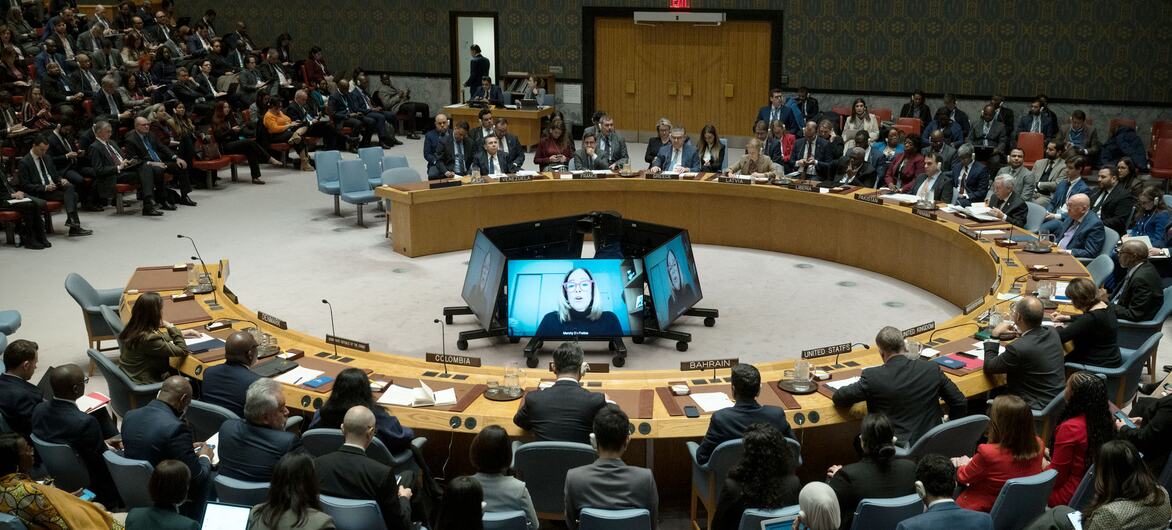
With a United Nations Security Council meeting today aimed at discussing the latest U.S.–Venezuelan developments, on behalf of the Secretary-General, Under-Secretary-General for Political and Peacebuilding Affairs, Rosemary DiCarlo, stated, “the Secretary-General is deeply concerned about the possible intensification of instability in Venezuela, the potential impact on the region, and the precedent the U.S. military operation may set for how relations between and among states are conducted.”
Describing the development as a blatant contravention of international law and a violation of the UN Charter, DiCarlo added, “respect for international law must remain the guiding principle, and the rules governing the use of force WERE NOT respected in the 3 January military action.” She recalled that the UN Charter is not an ambiguous forum and cannot be discarded whenever it suits the political and militaristic agenda of member states. DiCarlo urged member states to approach the UN Charter with a more dogmatic stance, noting, “In situations as confused and complex as the one we now face, it is important that the rule of law must prevail.”
DiCarlo would additionally call upon a lasting political solution to the “decades of internal instability and social and economic turmoil” endured within Venezuela. She calls on “all Venezuelan actors to engage in inclusive dialogue that allows all sectors of society to determine their future, grounded in respect for human rights, the rule of law, and the sovereign will of the people.”
Also in his remarks to the Security Council, Permanent Representative of the United States to the United Nations, Mike Waltz, noted, “Maduro was an illegitimate so-called President. He was not a head of state, and for years, Maduro and his cronies have manipulated Venezuela’s electoral system to maintain their illegitimate grip on power.” Waltz added that Maduro is “responsible for destabilizing the Western Hemisphere and illegitimately repressing the people of the country.”
In his reaction within the Security Council, Permanent Representative of Russia to the United Nations, Vassily Nebenzia, remarked that the “assault on the leader of Venezuela, compounded by the deaths of dozens of Venezuelan and Cuban citizens, in the eyes of many has become a harbinger of a turn back to the era of lawlessness and U.S. domination.” Russia condemned the attack by the United States, adding that it is a “cyclical crime to which there is no legal justification.”
Venezuela, and its Permanent Representative to the United Nations, Samuel Moncada, outlined the hypocrisy of U.S. claims, attesting that the deviation of accountability toward blatant acts of dismissal of international law, predicated on the notion of self-defense against narcoterrorism, has no legal, moral, or political legitimacy within the Security Council and its deliberative forum. Moncada particularly noted that the United States, and specifically its Permanent Representative, have a historical record and hallmark of “participation in processes of political destabilization and the promotion of institutional breakdown both within its own country and abroad.” Therefore, Moncada holds with contempt that attempts to use such manipulative narratives to “justify the use of force” are promoted in ill faith and used to legitimize a particular political resolution. He adds that the attack not only “destroyed civilian infrastructure and essential infrastructure,” but that the “kidnapping of the constitutional President of the Republic, Nicolás Maduro, and his wife” marks a flagrant infringement of legal principles.