Security Council says Middle East War weakens Syria’s fragile stability
Convening today on the political and humanitarian situation in the Syrian Arab Republic, Council members, presided over by United States Special Envoy to Syria Tom Barrack, say the Middle East war risks Syria’s nascent recovery process.

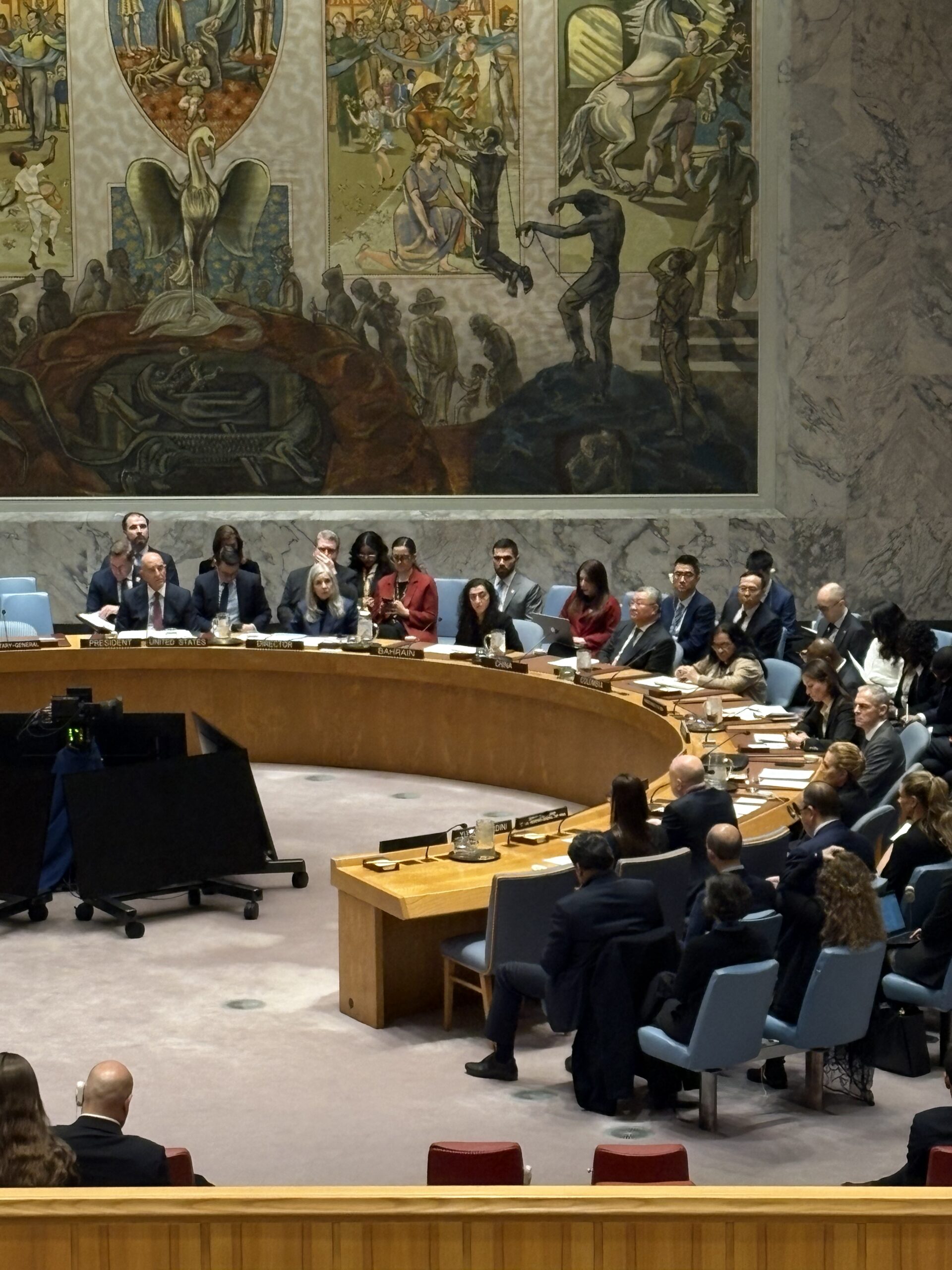
United Nations, New York City
Sphinx News: Ahmed Ali
As the Middle East War wages to nearly three weeks of regional devastation, Security Council members warn that ongoing hostilities endanger Damascus’s novel attempts at state sustainability, plunging the already fragile country into further security and economic despair.
REMARKS BY UNITED STATES SPECIAL ENVOY TO SYRIA, TOM BARRACK
Presided over by United States Special Envoy to Syria, Tom Barrack, he speaks of a revitalized and politically engaged nation. Barrack applauded the administration in Damascus for their efforts at “comprehensively integrating” all communities and “combatting terrorism,” working in conjunction with “the United States and other members of the global community.”
Acknowledging the recent intense fighting between Syrian Democratic Forces (SDF) and the Syrian Armed Forces in the state’s northeastern provinces earlier this year, Barrack noted that the eventual ceasefire agreement reached in late January “provides real protections for the Syrian Kurds, and brings the northeast’s civilian and military structures under national control.”
Referencing Syria’s political realignment “facilitated by U.S President Donald Trump,” Barrack says Damascus has “rejected Tehran’s malign influence and expelled remnants of the Islamic Revolutionary Guard Corps.”
Ambassador Barrack equally welcomed the country’s participation in the “D-ISIS Coalition”, which has “conducted joint operations to disrupt the terror networks of ISIS, al-Qa‘ida, and Hezballah, along with the Iranian-aligned groups.
As the United States and Israel remain in war with the Islamic Republic, Barrack contends that such efforts have stifled “Iran’s terrorist proxy,” further posturing the region against “Iran’s so-called axis of resistance.”
Positing that Syria has gradually “moved towards peace,” Barrack says, “Well over two million refugees and internally displaced have now returned home, where they can contribute to the rebuilding of their country.”
Massively uplifting in his appeals, Barrack’s speech praised Damascus for its institutional restoration, calling on other members of the United Nations Security Council to “enhance Syria’s counterterrorism capabilities, contribute to its reconstruction, and repatriate third-country nationals from displaced persons camps and detention facilities,” mitigating the widely acknowledged displacement crisis resulting from years of civil war and economic vulnerability.
KURDISH CONTENTIONS
Despite the optimistic trajectory of his rhetoric, supplanted with the Trump administration’s purported efforts at fostering Syria’s “peace with itself and its neighbors,” Syrian Kurds have been widely polemical of Tom Barrack’s diplomatic efforts. On January 20th, Barrack took to X to announce that, in the Trump administration’s eyes, the “original purpose” of the Kurdish-led Syrian Democratic Forces (SDF) “as the primary anti-ISIS force on the ground has largely expired.” He went on, “Damascus is now both willing and positioned to take over security responsibilities.”
For Kurds inhabiting Sheikh Maqsoud and Ashrafieh, Kurdish-majority neighborhoods in Aleppo where deadly battles between the SDF and SAF recently ensued, Barrack’s acquiescence with Syria’s dispatchment of armed forces undermined efforts to preserve any sliver of ethnic autonomy for the long-standing Kurdish plight. According to the United Nation’s International Organization of Migration (IOM), over 6,000 Syrian civilians (the large majority being ethnic Kurds) were forced to flee from their homes into displacement camps in Aleppo and al-Hasakah governorate.
REMARKS BY UN OFFICIALS
Missing from Barrack’s brief remarks were the Israeli administration’s seemingly perpetual efforts at destabilizing the Syrian state, a notion which remained highly prevalent in remarks delivered by Claudio Cordone, Deputy Special Envoy of the Secretary-General to Syria.
Cordone highlighted that the Israeli state continues to occupy Syria’s internationally recognized Golan Heights. Spanning an estimated 700 miles long, the Golan Heights has been encroached upon since 1967, where experts suggest that Israel remaining in the territory is not only a blatant contravention of international law, but an attempt to entrench its occupation, subsequently undermining the state’s sovereignty and territorial integrity.
Reaffirming its illicit nature, Deputy Envoy Cordone states, “we (the United Nations) reiterate our call in this context on Israel to fully respect Syria’s sovereignty and territorial integrity, adhere to the terms of the 1974 Disengagement of Forces Agreement, and refrain from any actions that could undermine Syria’s stability and political transition.”
Israeli efforts had also heightened last summer, where, in July of 2025, Tel Aviv said that it struck near the entrance to the Syrian Ministry of Defense in Damascus. The IDF (Israeli Defense Force) maintained at the time that such strikes were an effort to preserve the ethnic status quo and self-sustainability of the Druze population (an Arab minority group with deep historical and social ties to the Israeli state) in the Syrian Sweida province, a direct response to renewed fighting between armed Druze and Syrian Armed Forces. Syrian officials have since condemned Israel’s involvement in the conflict, noting that such foreign interventions curtailed Damascus’s efforts at consolidating control over their territory.
Nonetheless, Deputy Envoy Cordone spoke to the regional implications the ongoing Middle East War has had, exemplified by the current domestic turmoil of the Syrian state. As antagonisms exacerbate between the IDF and Hezbollah in neighboring Lebanon, Cordone says such developments have deepened a regional displacement crisis, where “approximately 140,000 people” are seeking refuge in the already decrepit Syria. Such a large influx of migration undermines the state’s already debilitated public sector.
Commenting on the impact military procedures have had directly, he added, “Incidents inside Syrian territory have mainly involved the crashing of debris following interception of Iranian missiles and drones in Syrian airspace, causing civilian casualties, and one incident of shelling from Lebanon attributed to Hezbollah.”
He warns that, if regional efforts are not conducted to halt the war, large-scale repercussions will gradually destruct the Syrian state, eroding its “steady but fragile recovery.”
Ms. Msuya, the UN Deputy Emergency Relief Coordinator, echoed the concerns of the Secretary-General’s Special Envoy, concentrating her report on the humanitarian aspects of the crisis. She told the Council, “For Syria, this escalation adds new strain at a fragile moment – one that still offers a genuine opportunity for progress.”
Security risks have led the Damascus government to shut down its airports, recessing efforts aimed at “economic recovery” and “reliance on large-scale humanitarian assistance.”
REMARKS BY MEMBER STATES
Permanent Representative of the Russian Federation to the United Nations, Vasily Alekseyevich Nebenzya, recalled in his speech Russia’s continued denouncement of the ongoing Middle East War.
The Russian Ambassador told the Council, “The US-Israeli confrontation with Iran is engulfing more and more states of the region, including Syria, a country recovering from the repercussions of a 14-year-long bloody civil war.”
He notes with particular concern the conflict’s spillover into Lebanon and Damascus, subduing both administrations to a torrid refugee crisis that risks broader domestic turmoil.
Echoing the sentiment of Special Envoy Cordone, Nebenzya stated, “The situation is exacerbated by the ongoing Israeli occupation of the Golan Heights and other territories in southern Syria, which can be used as an additional stronghold for Israeli attacks on Hezbollah positions, thus triggering retaliatory strikes on Syrian soil.” He condemned the Israeli administration’s efforts at “interfering in the internal affairs of Syria on the pretext of protecting ethnic and religious minorities,” ending his critical motion with a strong call to halt “any provocations that have the potential to fan the flames of war.”
Permanent Representative of Syria to the United Nations, Ibrahim Olabi, weighed in on the discussions surrounding his country, stressing within his national capacity that this current administration is “a new Syria, proud of its rich pluralism and diversity.”
He insisted that Syria remains steadfast in its “transitional justice and missing-persons bodies, elections, and continued integration efforts,” affirming Damascus’s unwavering decree to uphold the “cultural and linguistic rights” of the Kurdish people. He ended with a strong statement on Syria’s politics and social resilience, professing with emotional gratitude that Syria can “come together under one banner and one future”.