UN pleads for release of Kuwaiti-American Journalist
Ahmed Shihab-Eldin arrested in Kuwait over comments on the Middle East war; United Nations calls for release, warns of broader free speech suppression in the Persian Gulf.

United Nations, New York City
Sphinx News: Ahmed Ali
Detained in Kuwait after he commented on videos and images related to the war in Iran, Ahmed Shihab-Eldin becomes the latest example of the Gulf’s free speech repression, a precedent the United Nations warns poses great peril.
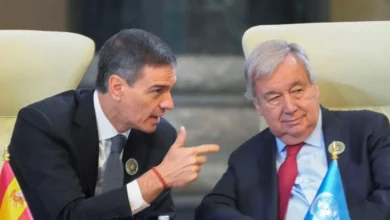
Calling for his immediate and unconditional release, Spokesperson for the Secretary-General, Stéphane Dujarric, told Sphinx, “We would like to see his detention come to an end. Journalists should be free to report without fear of detention, fear of harassment, or worse.”
With such a development posing a greater risk to the impunity of journalist subversion, a phenomenon that has particularly run rampant in contemporary global affairs, Dujarric noted, “we have seen journalists being harassed, being detained, and killed in that region and far beyond, at increasing rates. So, we want to see him set free.”
With conditions initially unclear when Eldin was first apprehended, the Committee to Protect Journalists said, on Monday, April 13, “It is understood that authorities have charged him with spreading false information, harming national security, and misusing his mobile phone — vague and overly broad accusations that are routinely used to silence independent journalists.”
Ahmed Shihab-Eldin, a longtime journalist who has worked alongside VICE Media, HuffPost, Al Jazeera, The New York Times, and PBS, is an award-winning journalist who posts prolifically on social media. As of March 2nd, it is understood that Eldin has not posted anything on any of his socials, a development that coincidentally coincides with his routine polemics around the ongoing Iran war.
According to the Committee to Protect Journalists, Eldin commented on publicly available videos and images related to the Iran war. His recent posts included a geolocated video, verified by CNN, showcasing a U.S. fighter jet crash near a U.S. air base in Kuwait.
With states of the Gulf Cooperation Council involved in the wider escalation around the region, Kuwaiti authorities, and other Gulf countries, have imposed increasingly tight censorship over the press. On March 2, a few days after the start of the Iran war, Kuwait’s Ministry of Interior warned against filming or publishing videos or information related to Iranian attacks, noting that several people were arrested for spreading false news. The Ministry of Information has also referred individuals accused of violating media laws to the Public Prosecution.
On March 15, Kuwait enacted Law No. 13 of 2026, legislation aimed at “safeguarding and protecting the supreme interests of military authorities, including the army, police, and the National Guard.” Article 26 imposes prison sentences up to 10 years for anyone who “disseminates news, publishes statements, or spreads false rumors related to military entities” with the intent of undermining confidence in them.
Stringent measures taken against the press are not new to the internal affairs of Gulf countries, where, in the United Arab Emirates and Qatar, for instance, authorities have arrested hundreds of people since the war began. The measures, similar to comments made by Kuwait’s Ministry of Information, are active attempts to mitigate the Gulf’s “legitimate security interests.”
Global analysts, however, see such adamant restrictions on free speech as more reflective of a wider, more systematic campaign, one designed to preserve the presupposed marketable status quo of the Gulf states. Long reliant on foreign investment, and more recently tourism as a sustainable means of economic revenue, highlighting the openly precarious threat may spoil that longstanding image, circumscribe foreign investment, and devastate the Gulf’s image in the eyes of Western and Global South investors.
In her remarks, Sara Qudah, the regional director for the Middle East and North Africa at the Committee to Protect Journalists, said “Journalism is not a crime,” adding that Mr. Shihab-Eldin’s case “reflects a broader pattern of using national security laws to stifle scrutiny and control the narrative.”