UN Security Council Pressed on ‘Fragile’ Gaza Peace Plan as Israel Blasts UN Rapporteur
Danny Danon condemns Reem Alsalem over her comments on October 7th while the Council reviews ceasefire progress amid mounting allegations of violations by both sides.

United Nations
Sphinx News: Ahmed Ali
As the Security Council meets to discuss the latest developments on the ‘fragile’ Gaza peace plan, Israeli Ambassador Danny Danon slams UN Special Rapporteur on violence against women and girls, Reem Alsalem.
The Special Rapporteur was met with strong condemnation by Israeli officials and media outlets after a series of claims she made on November 20th. The claims, released by Alsalem on X, concerned the Hamas October 7th attacks. The Special Rapporteur wrote, “no independent investigation found that rape (by Hamas members of the Al Qassam Brigades militia organization) occurred on October 7th, 2023.”
Alsalem’s comment was immediately met with outrage, with the Permanent Representative of Israel to the United Nations, Danny Danon, calling the statement a “shameful, and moral disgrace.” The Israeli envoy added, “Any U.N. representative who denies Hamas rape must be removed from their post. Period.”
Danon followed this statement by urging the United Nations Secretary-General to take steadfast and comprehensive action, mentioning that his “silence is complicity.” Deciding not to remove Alsalem would constitute a further “stain on the U.N.’s reputation.”
On the progress of the ceasefire, Danon suggests that “Israel is fully committed to meeting our obligations under Trump’s comprehensive plan to end the Gaza conflict.” He adds that Israel has remained in compliance with its end of the ceasefire deal by allowing: hundreds of humanitarian trucks to enter Gaza each day, “marked the yellow line” (a demarcated military line indicating Israel’s military withdrawal under phase one of the agreement), “we have released terrorists,” and have “coordinated closely with our international partners.” Despite Danon’s claims, sources on the ground indicate Israel has violated the terms of the ceasefire over 497 times since the deal was signed on October 10th. This includes the death of over 300 Palestinians at the hands of the Israeli military.
Failing to address Israel’s violations, Danon highlights that it is Hamas who has continued violating terms of the agreement. He affirms, “they missed the 72-hour deadline to return the hostages, and they have already killed three of our soldiers.” The next phase, he says, “is the disarmament of Hamas. A ceasefire cannot survive while a terrorist organization keeps its weapons.”
While Danon criticizes Hamas, he praises the work of the Gaza Humanitarian Foundation, announced to have ended its mandate in Gaza today. Created by Israeli and American forces, the foundation was set up with the primary objective of distributing humanitarian aid throughout Gaza amid ongoing hostilities.
The heavily reported aid agency was instead massively criticized by major media outlets and the United Nations. Reports during the foundation’s ‘mission’ indicated that the GHF was used to lure Palestinians into aid sites, where more than 800 Palestinians died trying to get access to food, water, and urgent medical supplies. Danon asserted that the foundation “did very important work, and we appreciate their contribution and dedication.” Despite the foundation undergoing what Danon describes as “vicious attacks from the UN,” he says, “they helped many people in Gaza, and we appreciate that.”
On the Gaza Humanitarian Foundation, Spokesperson for the Secretary-General, Stéphane Dujarric, stated the end of the GHF has “no impact on our operations because we never worked with them.”
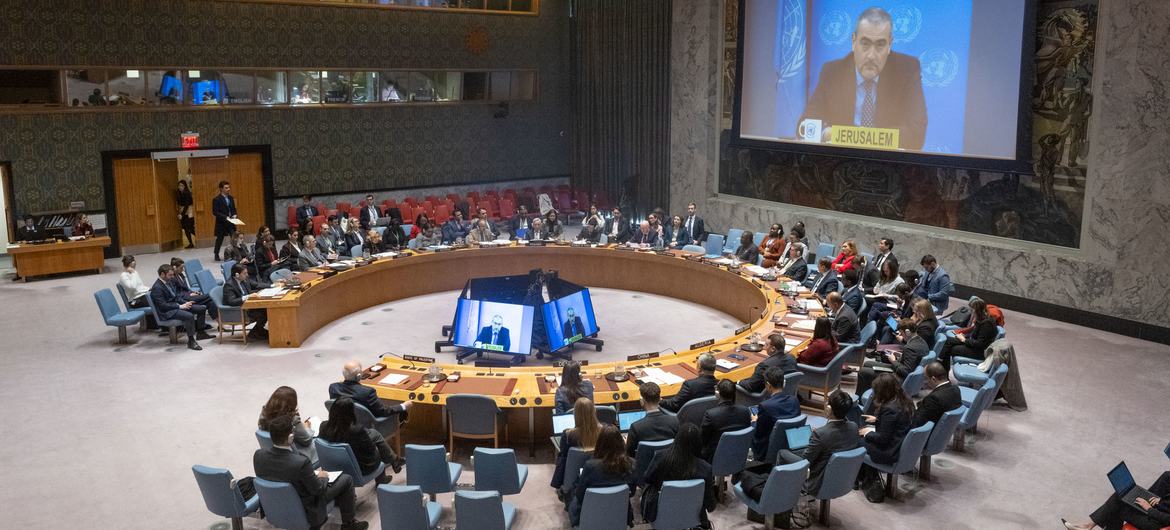
After Danon’s address to the press, the Security Council convened on its 10051st meeting to discuss the situation in the Middle East. The Council specifically discussed the “Comprehensive Plan to End the Gaza Conflict.” The Council acknowledged (despite its violations) phase one of the deal, noting the partial withdrawal of Israeli forces along the ‘yellow line,’ a significant scale-up in humanitarian aid, and the large exchange of hostages and Palestinian prisoners.
The second phase of the otherwise already ‘fragile’ peace deal will see the disarmament of Hamas, an expected further withdrawal of Israeli forces, transition of power to the ISF (International Stabilization Force), and the establishment of President Trump’s Technocratic Board of Peace. On November 17th, the Council endorsed this plan of action with the adoption of Security Council Resolution 2803.
The United States Representative outlined the path for phase two, stating, “the international community must move quickly to deny Hamas any chance to reconstitute,” urging member states to pledge personnel, equipment, and funding for the Force.
In his briefing over the Council, Ramiz Alakbarov, Deputy Special Coordinator for the Middle East Peace Process, spoke of the ceasefire’s improvement to the situation on the ground. However, he cited continued Israeli ceasefire violations and attacks throughout the strip, as well as sporadic clashes between Palestinian militants and Israeli soldiers. These events, he contends, “jeopardize the fragile truce.” Therefore, to maintain the ceasefire, Alakbarov urges all parties to completely cease hostilities. He also calls on Israel to expand crossing capacity, mentioning that only three Gaza crossings are currently open for large-scale aid distribution by the United Nations and other relevant partners (Kerem Shalom, Kissufim, and Zikim).
Riyad Mansour, Permanent Observer of the State of Palestine, welcomes the Gaza peace proposal as an effective diplomatic solution but notes Israel’s consistent violations as “attempts to undermine the already fragile agreement.” He adds, “Gaza is Palestinian… Gaza is the bleeding heart of Palestine, just as Jerusalem is its beating heart.”
The Council, however, duly noted by Russia’s Permanent Representative to the United Nations, Vasily Nebenzya, remains concerned about the ambiguity of Resolution 2803. Referring to the Resolution and 20-point peace plan’s failure to include Palestinian representation, he says, “When will the Palestinian Authority return to Gaza? When will Israel withdraw its troops from the Strip? How will Hamas be disarmed?”