Sudan at 1,000 Days of War: A Conflict at the Brink of Regional Collapse
As the Sudan civil war pervades across the Kordofan region, officials warn that foreign influence, impunity, and indiscriminate violence risk fueling a greater regional outbreak.


United Nations
Sphinx News: Ahmed Ali
As the Sudanese civil war reaches a staggering 1,000 days of violence, international outcry worsens, with officials suggesting broader regional instability to be an increasingly inevitable outcome.
As the year 2025 comes to an end, the Sudanese catastrophe has seen minimal political resolution and even less legal accountability. Despite renewed calls by the international community for immediate investigations into alleged war crimes, a comprehensive resolution that sees a civilian-led transition within Sudan’s political horizon, and an instantaneous halt of civilian violence, impunity, and belligerence have prevailed. The conflict, initially marked as one of twentieth-century trench-like warfare, has since evolved into a twenty-first-century modern military bonanza. Characterized by fueled geopolitical tensions, overly sophisticated military equipment, and little political settlement, the once local conflict now risks broader regional instability, threatening the fragile political and social fabrics of an already decrepit Horn of Africa.
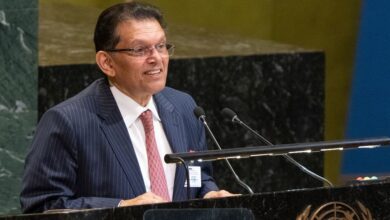
Addressing members of the press before his briefing to the UNSC (United Nations Security Council), Transitional Prime Minister of Sudan, Mr. Kamil El-Tayeb Idris, warned that Sudan is at a “crossroads” of immense proportions.With his administration’s overarching goal of “peace, accountability, and civil justice,” the latest nascent peace initiative presents an opportunity that can only be achieved with “shared international commitment.” The latest initiative, the Prime Minister holds, reflects a “realistic and peaceful departure from war,” supported by the United States, Egypt, and Saudi Arabia. Their leadership has been “critical to advancing the prospect of peace,” with a U.S.-led peace plan called the “Quad Initiative.” Detailed by U.S. Secretary of State, Rubio, as a “comprehensive plan of action,” the initiative outlines a three-month truce, followed by a permanent ceasefire, leading to a nine-month transition to civilian rule. Despite the deal’s heavy diplomatic backing, where international action has otherwise been scant, both the RSF and SAF have not agreed to such a deal.
With the Secretary-General calling the conflict today a profound “international failure,” the work of outside state influence has heightened tensions as opposed to precluding them. Spokesperson for the Secretary-General, Stéphane Dujarric, told reporters, “I think he’s (the Secretary-General) extremely frustrated, not only for the lack of effort, but I think frustrated at the level of human suffering that we’ve been seeing in Sudan this year.” He added, “This year has seen shelling of camps, where famine had been recorded, and where people were starving. We’ve seen gunmen go into hospitals, maternity wards, killed women, killed babies, and killed doctors. Those are just two of the most egregious things that we’ve seen. We’ve seen the bloody aftermath of the RSF (Rapid Support Forces) takeover in El Fasher. We’ve seen, as the Secretary-General put it, interference on the negative end by countries in the region and afar.”
The exceeding brutality witnessed, particularly within the last year, has transitioned progressively farther and farther away from any conception of basic humanitarian and legal principles. The Secretary-General underscores that when understanding this objective reality of how the conflict has evolved, a lack of political will and an “element of racism” are particularly glaring. Dujarric noted, “People don’t pay as much attention to crises in the global media, crises in Africa, as they do in other parts of the world. There are also a lot of crises going on, a lot of human suffering. But we have to be able to keep all of these issues up front.”
Echoing the sentiments of Dujarric and the Secretary-General, Mr. Khaled Khiari, Assistant Secretary-General for the Middle East, Asia, and the Pacific, briefed the Security Council on the latest developments on the ground. As a representative of the United Nations Department of Political and Peacebuilding Affairs (UNDPPA), Khiari contended that the conflict has “in fact intensified.” Confirming renewed attacks on civilians and civilian infrastructure, Khiari stated that “civilians are enduring unimaginable suffering with no hopes in sight,” citing the epicenter of transgression to now be within the west and south of the Kordofan region.
On December 1st, the RSF captured Babanusa in West Kordofan, followed by their capture of Heglig in South Kordofan on December 8th. The capture of Heglig particularly marks a grave escalation, with the area home to a variety of integral oil production facilities connecting economic activity between South Sudan and Port Sudan, a city in Sudan. Since its capture and eventual siege, SAF members fled to South Sudan, with reports indicating that South Sudanese forces are now mobilizing and headed towards both recently captured cities in the Kordofan region. Khiari remarked that these developments are “complex,” stressing the “expanding regional dimensions of the conflict.” If unaddressed, Khiari warned, “Sudan’s neighbors could become embroiled in a regional conflict in and around Sudan.”
Also in the Security Council, Ms. Edem Wosornu, Director of the Crisis Response Division at the Office for the Coordination of Humanitarian Affairs, proclaimed that the violence within the Kordofan regions has “severely restricted humanitarian access.” Additionally, between December 4th and December 16th, she added, “the United Nations High Commissioner for Human Rights has reported more than 100 civilians dead from drone strikes,” along with exceeding reports of artillery shelling, forced recruitment, sexual violence, and forced displacement within the North Kordofan State.
Mr. Cameron Hudson, an independent analyst and consultant on African security, governance, and geopolitics, perceived the overall nature of the international response as a glaring failure, characterizing the conflict as an “unconscionable” humanitarian catastrophe fueled by modernized twenty-first-century war tactics.
Addressing the Security Council, Hudson recalled that the risk of state partition and catastrophic displacement is imminent, threatening to destabilize the entire Horn of Africa and send “shockwaves of refugees and extremists” across the Sahel and the Mediterranean. Hudson, well revered for his twenty-five years of work in international politics, heavily critiqued the international response as “highly insufficient,” adding, however, that “not all countries bear equal responsibility for fueling this conflict.” Hudson pointed specifically to the role played by the UAE, critiquing the Gulf state’s use of wealth and influence “across the Horn of Africa to construct an extensive military airbridge operation flying weapons into the RSF, via regimes in Chad, Libya, South Sudan, the Central African Republic, and Somalia.” With little justification, Hudson condemned the UAE as subsidizing state atrocity, urging members of the Security Council and the international community to avoid “diplomatic ambiguity” and instead “act tangibly.” Working to hold both foreign and state perpetrators accountable is critical, with Hudson also recommending that the international community expand its 2004 arms embargo across the entire country, and press the International Criminal Court to expand its investigation into all crimes committed during the conflict.