Board of Peace, what does this mean for the UN?
As United States President Donald Trump sends requests for states to join his Board of Peace—effectively pushing its mandate beyond what was originally intended to be limited to Gaza—how does the United Nations respond?

United Nations
Sphinx News: Ahmed Ali
As of this Saturday and Sunday, U.S. President Donald Trump has begun sending invitations to world leaders and other prominent figures to take part in his new Board of Peace (BoP). Originally intended as a transitional governing force tasked with “fixing” the decrepit Gaza enclave, the United States’ recent actions insinuate an intention to alter the Board’s intended mandate, viewing its function as potentially auspicious in consolidating its global hegemony.
Initially, as outlined in Trump’s 20-point Gaza Peace Plan, the Board of Peace would be a transitional governing force tasked with overseeing adherence to and full implementation of Phase Two of the Gaza ceasefire plan. Following Israel’s intended withdrawal to the so-called “yellow line,” along with a hostage exchange and a presupposed complete halt of violence, the Board of Peace would oversee “governance capacity-building, regional relations, reconstruction, investment attraction, large-scale funding, and capital mobilisation” for the Gaza Strip.
However, in light of recent letters written by Trump and posted to social media on Saturday by two leaders invited to be part of the Board—Argentinian President Javier Milei and Paraguayan leader Santiago Peña—the Board’s wider political and potentially economic ambitions have become more apparent. In Trump’s letter to Milei, the U.S. president stated that the Board would seek to “solidify peace in the Middle East,” adding that it would “embark on a bold new approach to resolving global conflict” at the same time.
The BoP’s 11-page charter, comprising eight chapters and 13 articles, not only does not mention Gaza once in any of its provisions but also indicates a novel governance structure. Outlined within the charter, the governance structure has three layers: the Board of Peace, an executive board, and a chairman with sweeping authority.
According to the White House, the “founding executive council sits at the top. The Board of Peace votes on budgets, policy, and senior appointments, while the executive board, which consists of eleven members, is responsible for implementing the mission.”
Members of the executive board who have already been announced include former United Kingdom Prime Minister Tony Blair, U.S. Secretary of State Marco Rubio, Trump’s son-in-law Jared Kushner, U.S. Special Envoy Steve Witkoff, Turkish Minister of Foreign Affairs Hakan Fidan, Qatari diplomat Ali Al Thawadi, UN Middle East peace coordinator Sigrid Kaag, United Arab Emirates Minister of State for International Cooperation Reem Al-Hashimy, and Israeli-Cypriot billionaire Yakir Gabay. The chairman of the organization would be Donald Trump himself, serving as the final authority on the interpretation of the charter and holding exclusive veto power over key decisions, including membership removal and executive board actions.
Within the composition of the Board of Peace itself, invitations have reportedly been sent to over 60 states and their respective heads of government. Beyond Argentina’s Milei and Paraguay’s Peña, Türkiye and Egypt have confirmed their respective leaders—Recep Tayyip Erdoğan and Abdel Fattah el-Sisi—as official members of the Board, as well as, most recently, Israeli Prime Minister Benjamin Netanyahu.
Other states that have reportedly joined the Board include Saudi Arabia, Jordan, Indonesia, Pakistan, Qatar, Albania, Armenia, Azerbaijan, Belarus, Hungary, Kazakhstan, Kosovo, Morocco, Paraguay, the UAE, Uzbekistan, and Vietnam. Reports indicate that leaders of the European Union, as well as leaders of France, Germany, Australia, and Canada, were also invited to sit on the Board. Despite no further confirmation, the United States has revealed that more members will be announced in the coming days and weeks.
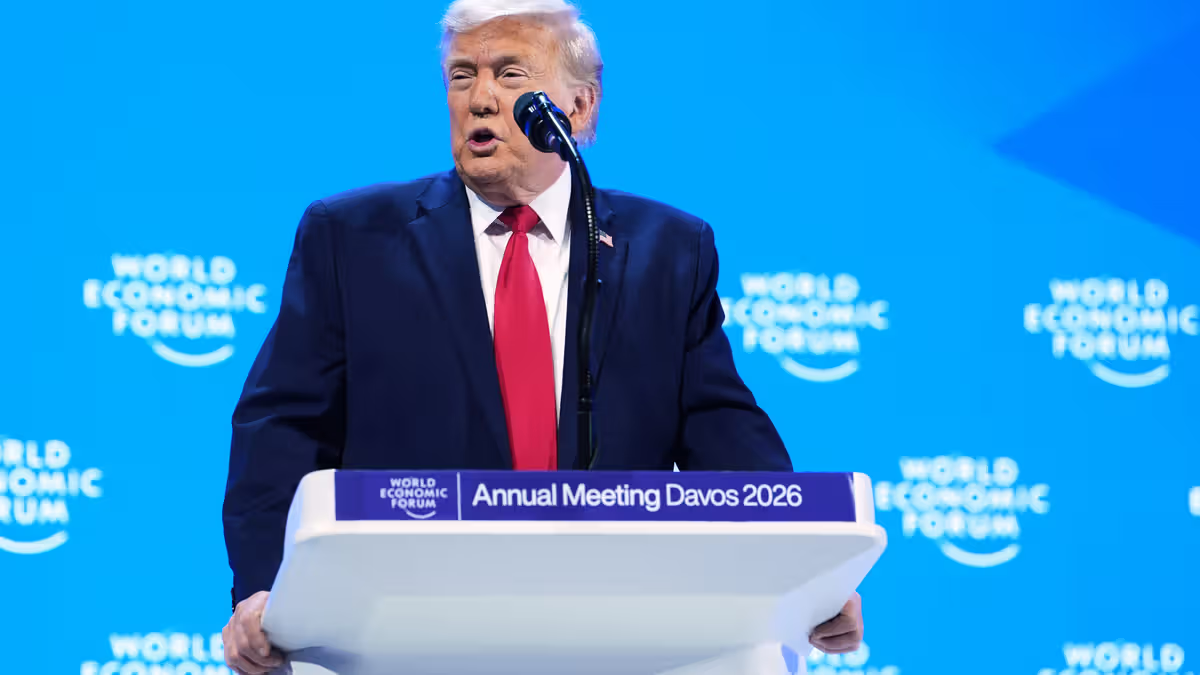
Additionally, the United States is expected to hold tomorrow an official signing ceremony for the Board of Peace on the margins of the World Economic Forum (WEF) in Davos, Switzerland.
While the organization is not officially constituted to fulfil any of its intended mandate just yet, its nascent development has already been met with a particularly strong sense of contention and caution by members of the international community. Commenting on the United States’ historical propensity to assert itself as the dominant global hegemon, China’s Vice Premier He Lifeng, speaking at the Davos WEF, expressed scepticism regarding the development’s potential promotion of global anarchy, remarking: “The world cannot return to the law of the jungle, where the strong prey upon the weak. A select few countries should not be able to take what they want from the weak who can do nothing to stop them. That is not the world we set up.”
Perhaps emblematic of these Chinese concerns, President Donald Trump expressed extensive praise for the organization’s potential, underscoring what he framed as its prospective political and diplomatic replacement of the United Nations. Speaking to reporters at the White House yesterday, Trump stated: “I wish the United Nations could do more. I wish we didn’t need a Board of Peace, but the United Nations—and, you know, with all the wars I settled—the United Nations never helped me on one war.”
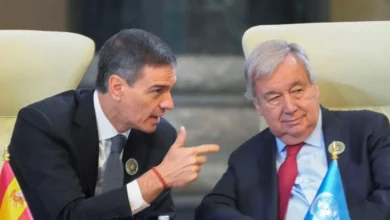
Nonetheless, the latest reaction from the United Nations, particularly from its Secretary-General’s office, can neither be regarded as solicitous nor deeply wary. Deputy Spokesperson for the Secretary-General Farhan Haq reminded reporters that, with regard to the Board of Peace’s outlined mandate, “what we are aware of is that the Security Council has endorsed it with regard to its work in Gaza.”
However, Haq added that “there have been a number of regional and bilateral organizations that have coexisted and sometimes worked in conjunction with the United Nations,” but with regard to the Board of Peace specifically, “it is too early to tell what it will look like.”
Questioned on the Board’s potential imposition on the functions of the United Nations, Haq responded: “The Board of Peace, in terms of what it will be doing, remains amorphous. We are sticking to our program, and we are not worried about what any other grouping is doing.” Haq further emphasized that the United Nations will continue to “work relentlessly for peace, in full respect for international law, and apply a comprehensive effort to address the root causes of conflict, ensuring sustainable efforts aimed at peace.”