Arab States and Israel Clash at Security Council Over Gaza Ceasefire and West Bank “De Facto Annexation”
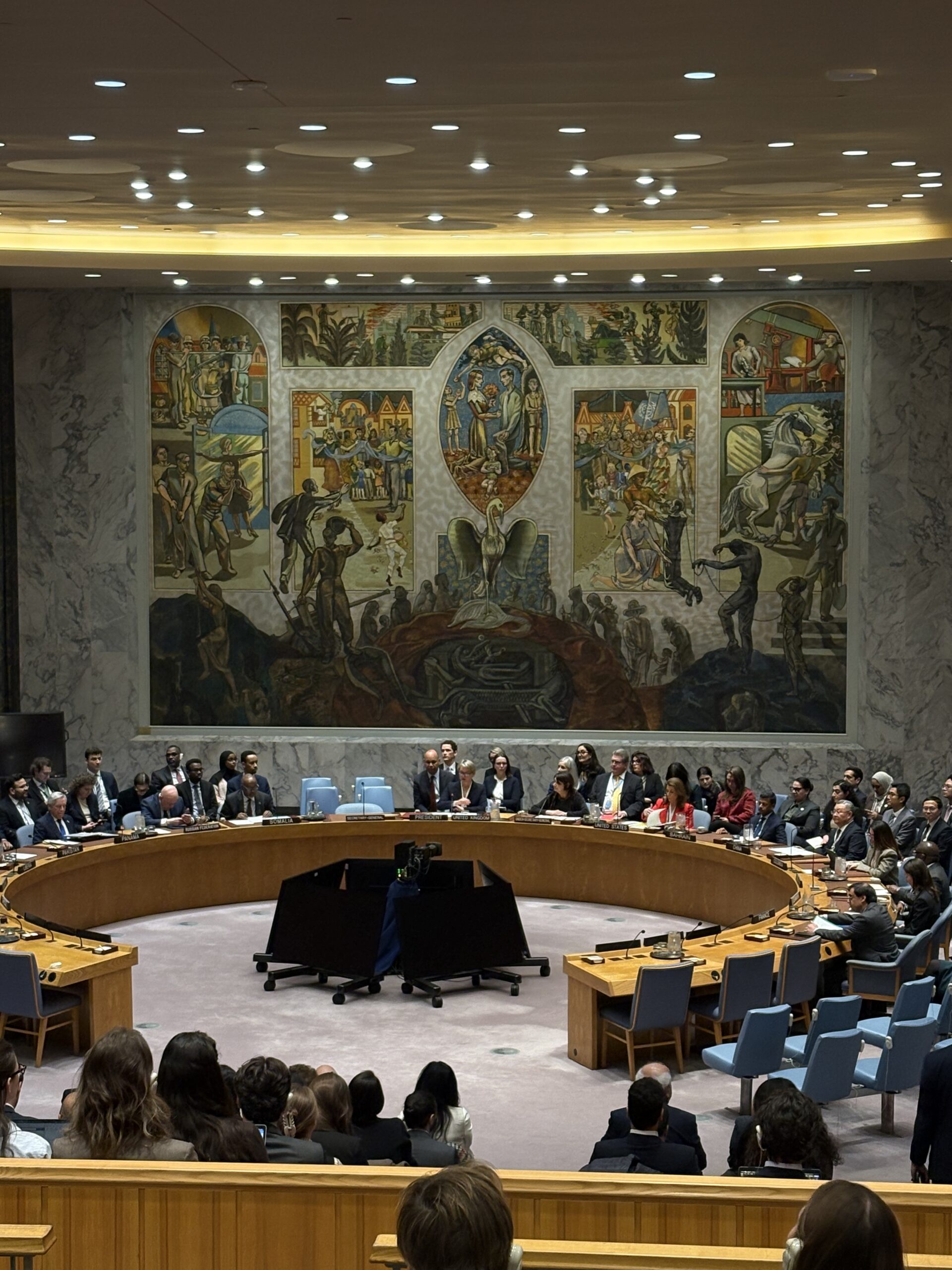
As the United Nations Security Council convenes for its 10,108th meeting, rising tensions in the West Bank and the uncertain future of phase two of the Gaza ceasefire thrust ambassadors and foreign ministers into a high-stakes debate over what comes next.

United Nations
Sphinx News: Ahmed Ali
At a high-level meeting of the United Nations Security Council today, senior UN officials, civil society representatives, and foreign ministers gathered to confront mounting uncertainty over phase two of the Gaza peace plan, denounce what several described as “de facto annexation” in the West Bank, and reassess the broader political horizon for Israelis and Palestinians alike.
Briefing the Council, Israel’s Foreign Minister, Gideon Saar, spoke of the United Nations as a forum for “replacing historical truths with modern lies.” Saar also detested any inquisition aimed at his administration’s activity within the occupied Palestinian territory. With utmost self-assurance, Saar vehemently retorted, “we are the indigenous people of the land of Israel.” Polemical in his rhetoric, Saar professed that the international community has a “hypocritical obsession with Jewish presence in the heart of our tiny land.” He regards Trump’s 20 point peace plan as a “monumental deal” in preserving Jewish communities in both Judea and Samaria, adding, “we will not abandon our heritage, security, and future to ease other countries’ domestic and political difficulties.”
Mr. Badr Ahmed Mohammed Abdelatty, Minister for Foreign Affairs, International Cooperation, and Egyptian Expatriates, dismissed Israel’s latest actions in the West Bank as a blatant contravention of international law and a grave display of political ignominy. Recalling Egypt’s hosting of the Gaza Peace Summit in Sharm El-Sheikh, the Egyptian efforts, in conjunction with the U.S. and other Arab states, have been aimed at fostering Middle Eastern security, “saving the region from open conflict.” The adoption of Resolution 2803 by the Security Council is welcomed by Cairo as a “binding international framework for implementation of the interim transitional arrangements in the Gaza Strip.” The resolutions, he posits, have been framed by the Israeli government as non-binding measures, where the absence of acquiescence by the government in Tel Aviv defies the legitimacy of the agreement and renders the summit politically futile. Minister Badr adds Cairo has been forthcoming in its efforts to implement Phase 1 of Trump’s 20 point peace plan, where the Egyptian authorities have “facilitated the change of hostages and removed Israeli obstacles to humanitarian access into the Gaza Strip.”
While Cairo has actively made efforts to adhere to the nascent political arrangement, Minister Badr contends that the following must still be done: “First, implement all the commitments of Resolution 2803… where Israel must stop using administrative obstacles to restrict full and safe humanitarian access. Second, efforts must be intensified for both early recovery and reconstruction” of the besieged enclave. On this note, Minister Badr adds that this reconstruction must not be limited to physical transformation, noting that a critical and collaborative initiative must be made to transcend Gaza’s “social structure, basic services,” and institutions. Only with political will, however, can this transformation ensure “decent living opportunities for the Palestinian people.” Third, “members of the Palestinian national committee (set up within the 20 point peace plan) must be able to enter all areas of the Gaza Strip” essential to managing the enclave’s day-to-day affairs and supporting the governance of the transitional Board of Peace. Fourth, both the ISF and Palestinian policing authorities must be adequately monitored with respect to the agreed-upon international mandate, tasked with both facilitating humanitarian distribution and maintaining the deradicalization of Gaza. Fifth, the Israeli authority must relinquish complete jurisdiction over Gaza, allowing for the Palestinian Authority to “be the sole bearer of arms under one comprehensive umbrella.”
Mr. Ayman Safadi, Deputy Prime Minister and Minister for Foreign Affairs of Jordan, echoed Egypt’s denouncement of the Israeli administration’s activity, adding that the “suffering in Gaza has not stopped.” The enclave, he says, is still riddled with starvation, broken institutions, and both a feeble and traumatized population. Welcoming Trump’s 20 point plan, the Jordanian Foreign Minister maintained that the agreement laid out progress toward peace. He noted, however, that Israel has remained in defiance of the agreement, violating the ceasefire “over 1,500 times since October 6th, 2025.” He note that the obstruction of humanitarian aid has equally hindered Palestinian reconstruction in Gaza. On the West Bank, Mr. Safadi warns that continued Israeli impunity over its illicit activities will result in de facto annexation, a growing reality which “the entire international community rejects.” Deterring the Israeli administration’s annexation of the West Bank is pivotal, as continued developments erode the possibility of “achieving a just peace through a two state solution.” Jordan therefore condemns any and all recent Israeli legislation over the West Bank as “seizure of Palestinian land,” as made clear with Security Council Resolution 242 of 1967.
Rosemary DiCarlo, Under-Secretary-General for Political and Peacebuilding Affairs at the United Nations, described the current juncture as a “pivotal moment in the Middle East,” one that could allow the region to move in a more positive direction. She stressed that decisions taken by Council members would determine whether sustainability, recovery, and lasting peace are possible.
DiCarlo pointed to the establishment of the Board of Peace created under Security Council resolution 2803, as “an important step” capable of advancing phase two of the Gaza peace plan. She said encouraging progress had been made since the ceasefire took effect last October, including the reopening of the Rafah crossing in both directions and expanded humanitarian deliveries. On Rafah’s reopening, UN teams, she added, are working with international stakeholders to facilitate safe travel and medical evacuations, with thousands still requiring urgent treatment outside Gaza.
However, she warned that “despite the ceasefire, Gaza is still not at peace.” The majority of the population continues to face severe living conditions, where Israeli airstrikes in late January and early February have killed many Palestinians in Gaza. She reiterated that the situation is “deteriorating rapidly”, elucidating Secretary General Guterres’ condemnation of resumed land seizure procedures and settlement expansion in the occupied West Bank as having “no legal validity.”
Pakistan’s Deputy Prime Minister and Foreign Minister, Mohammad Ishaq Dar, condemned what he described as Israel’s ceasefire violations and annexation attempts, calling recent measures “null and void” and in violation of international law, including Security Council resolution 2334 and the International Court of Justice’s 2024 advisory opinion. He stressed that a successful peace process requires a conducive environment made in good faith and pledged Pakistan’s participation in the Board of Peace.
Permanent Representative of the United States to the United Nations, Mike Waltz, defended President Donald Trump’s 20-point peace plan as a comprehensive path forward. He said the Board of Peace, established without objection by the Council, would convene its inaugural meeting in Washington with a focus on security and reconstruction.
Waltz announced that more than 4,200 trucks are now entering Gaza weekly and that over $5 billion in reconstruction pledges would be unveiled by the Board of Peace tomorrow as part of Gaza’s reconstruction. He underscored that “security and governance must come first,” insisting that Hamas “must and will disarm” and that reconstruction will not proceed in areas where demilitarization has not occurred.
“We had choices of Hamas controlling Gaza and occupation of Gaza, or a new way,” he said, urging member states to commit tangible support to the emerging framework.