UN Warns Iran‑U.S./Israel Conflict May Ignite Uncontrollable Regional Collapse
As the United States and Israel’s military escalation with Iran unravel, UN Secretary‑General Guterres warns it could spiral into broader chaos, threaten civilians and undermine regional security.

United Nations, New York City
Sphinx News: Ahmed Ali
Following a joint military operation on Saturday, launched by both the United States and Israel against the Islamic Republic of Iran, the UN Secretary-General denounced the escalations as “igniting a chain of volatility” throughout the region.
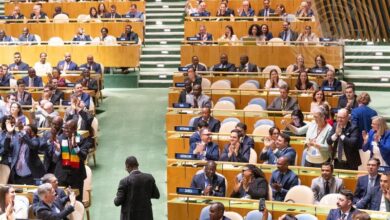
The development, later labeled by the Secretary-General as an existential threat to international peace and security, saw high-level delegations convene an Emergency Security Council session. Held on Saturday, February 28th, the session saw Secretary-General Guterres condemn the brazen military hostilities in the Middle East as a “contravention of international law,” where he underscored the necessity for both immediate de-escalation and a return to negotiations.
Guterres not only criticized the initial strikes by the United States and Israel as illicit in their very nature, but equally condemned Iran’s retaliatory strikes in Bahrain, Iraq, Jordan, Kuwait, Qatar, Saudi Arabia, and the United Arab Emirates as violating their sovereignty and territorial integrity. Failure, he added, at “restoring peace” in a war which has already displaced and killed hundreds of innocent civilians in a matter of days, risks heightening further regional instability, with exceedingly “grave consequences for civilians.”
Despite the vehement rhetoric, the Secretary-General has not yet condemned the killing of Iran’s Supreme Leader, Ayatollah Khameini. In a joint military incursion between the United States and Israel on Saturday called Operating Rising Fury, an aerial military offensive involving B-2 stealth bombers, fighter jets, and missiles targeted Iranian leadership in Ayatollah Khameini’s compound in Tehran. Iranian state media confirmed the Ayatollah’s death late on the same day. The Secretary-General told members of the Council before the reports had been confirmed: “Several high-ranking officials have reportedly been killed, including, according to Israeli sources, Iran’s Supreme Leader Ali Khamenei, whom I’m not in a position to confirm the situation.” As the reports have now been confirmed, the Secretary-General has still not released an official statement denouncing the death of the Ayatollah.
Nevertheless, the United Nations has aimed its initiatives at curtailing the interstate trepidation, with Secretary-General Guterres holding open diplomatic discussions with key regional actors. Today, Guterres held discussions with His Highness Sheikh Tamim bin Hamad Al Thani, the Amir of the State of Qatar. Noted by his spokesperson, Stéphane Dujarric, Guterres and Amir Al Thani highlighted “the urgent need to end the current military escalation and a return to dialogue in the interest of regional stability.”
Over the weekend, the Secretary-General also spoke with the Foreign Minister of the Sultanate of Oman, Sayyid Badr bin Hamad bin Hamood Albusaidi. The Secretary-General praised the Omani effort throughout February at facilitating high-level comprehensive dialogue between both Tehran and Washington.
Aimed at settling grievances around Tehran’s nuclear program, efforts at mediating discussions by the Omanis had reportedly yielded progress in the right direction, where Iranian Foreign Minister Abbas Araghachi told media in Muscat on February 5th that the meeting between both delegations was “a good start” held in “a very positive atmosphere.”
Spokesperson for the Secretary-General, Stéphane Dujarric, added today that the meeting between the SG and the Omani Foreign Minister echoed the sentiment of Guterres’s conversation with the Amir of Qatar, where both “expressed concerns about the risks posed by this war for the region.”
Nonetheless, as the war reaches its third day, the Secretary-General grows increasingly concerned at both the “humanitarian fallout” and “ongoing military escalations.” In his briefing to reporters, Spokesperson Dujarric highlighted, “The expansion of attacks to countries that were not involved in the initial attacks is particularly worrying. Whether we are talking about Gulf countries, Jordan, Syria, or Lebanon.”
While the hostilities and retaliatory Iranian attacks on Israeli soil have resulted in the complete closure of all humanitarian corridors into Gaza, military escalations have equally emboldened attacks by Hezbollah militants in southern Lebanon. On the latter, Dujarric notes the United Nations’ exceeding concerns for the safety of “political and peacebuilding presence along the Blue Line,” where UNIFIL remains in constant operation. The attacks between Hezbollah and Israel along the southern Lebanese borders have already, according to the United Nations, resulted in the death of over 31 civilians, with provocations equally contributing to the displacement of thousands in the area. Dujarric adds, “Both the Special Coordinator for Lebanon Jeanine Hennis-Plasschaert, and the UNIFIL Head of Mission and Force Commander Major General Diodato Abagnara, are engaging with the parties to de-escalate and preserve stability across the Blue Line.”
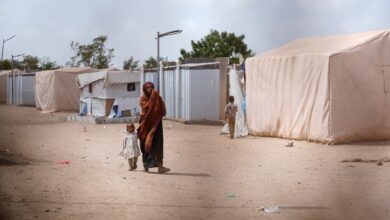
In Gaza, colleagues at OCHA have noted that hostilities have “completely disrupted humanitarian services.” As was already the case, UN agencies had increasingly criticized Israeli authorities for not allowing enough humanitarian supply into the decrepit enclave. The war over the weekend has amplified the situation, where Israeli authorities, Dujarric says, “have closed all crossings, including Rafah, have suspended humanitarian movements in and near areas where Israeli troops remain deployed in Gaza, and they have also postponed planned rotations for our humanitarian personnel.” Additionally, Dujarric noted, “Medical evacuations and the return of people into Gaza have also been suspended as a result.”
The severe shortage of supply has stifled the United Nations and its humanitarian operations, forcing the organization to “ration” medical services, food, and energy supply across the enclave. According to Dujarric, this reduction has “reduced water production to two litres of drinking water per day” and drastically inflated the “prices of basic commodities.”