White House insists war is over, UN needs clarity
With the House contending that the war on Iran is over, the UN remains concerned, calling for precision and respect for international law

United Nations, New York City
Sphinx News: Ahmed Ali
On Tuesday, May 5th, Secretary of State Marco Rubio told members of the press that “Operation Epic Fury is concluded. We achieved the objective of that operation.”
Despite the purported dogmatism of the statement, hostilities have remained, coupled with the war’s recurring theme: uncertainty and diplomatic ambiguity.
In an attempt to try to convince journalists at the White House that the United States has conducted a successful operation, Rubio added that the ongoing effort to reopen the Strait of Hormuz is entirely a defensive and humanitarian operation, one which would only create belligerence “only if the United States was attacked first” by Iranian vessels.
Later on Tuesday, U.S. President Donald Trump announced that he was pausing even that effort, taking to Truth Social to say, “Based on the request of Pakistan and other Countries, the tremendous Military Success that we have had during the Campaign against the Country of Iran and, additionally, the fact that Great Progress has been made toward a Complete and Final Agreement with Representatives of Iran, we have mutually agreed that, while the Blockade will remain in full force and effect, Project Freedom (The Movement of Ships through the Strait of Hormuz) will be paused for a short period of time to see whether or not the Agreement can be finalized and signed.”
Beginning early Monday, “Project Freedom” was referred to by U.S. government officials as an effort to escort commercial ships through the Strait of Hormuz.
Trump dubbed the military venture a global necessity, taking to Truth Social to say, “The Ship movement is merely meant to free up people, companies, and Countries that have done absolutely nothing wrong – They are victims of circumstance.”
The campaign, the U.S. president said, came at the request of countries whose vessels remain stuck in the strait, which he described as “neutral and innocent bystanders”.
He added that U.S. envoys were holding “positive” discussions with Iran, but warned that any interference with the operation would “have to be dealt with forcefully.”
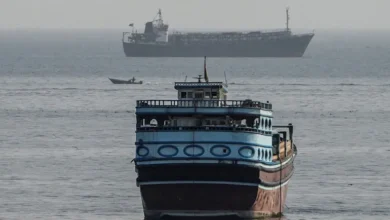
In almost conjuring fashion, the “project” fostered a renewed wave of military escalation on its very first day, with Tehran launching an open-fire attack on U.S. warships near Jask, a port in the Strait of Hormuz located between Iran and Oman.
According to U.S. Central Command (CENTCOM) leader Adm. Brad Cooper, the United States responded by sinking six small Iranian boats. Cooper additionally told reporters that he “strongly advised” Iran to steer clear of U.S. military assets as the “Pentagon proceeds with Project Freedom.” On the U.S. naval blockade, which has been barring vessels departing from Iranian ports from leaving the region since April 13th, Cooper affirmed that it will remain in effect, excluded from the objectives of “Project Freedom.”
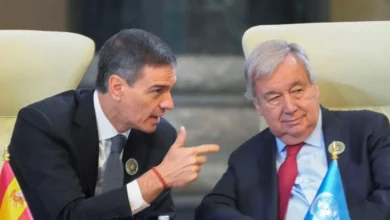
The United Nations immediately expressed concern, with Stéphane Dujarric, Spokesman for the Secretary-General, telling reporters yesterday after the strikes had taken place, “We call on all parties to exercise maximum restraint and refrain from any actions which could escalate tensions and undermine ongoing diplomatic and mediation efforts.”
As far as “ongoing diplomatic and mediation efforts” are concerned, here are the latest proposals presented by both the United States and Iran:
In a one-page U.S. memorandum proposal, facilitated by Islamabad (the main conduit for alleviating political tensions), the United States outlined a nine-point proposal, primarily centered on a two-month ceasefire agreement and the immediate reopening of the Strait of Hormuz as foundations for a long-standing arrangement.
However, in its latest peace proposal, Iran said it wants to focus on ending the war instead of extending the truce and wants all issues resolved within 30 days.
The new proposal calls for guarantees against future attacks, a withdrawal of U.S. forces from around Iran, the release of frozen Iranian assets worth billions of dollars and the lifting of sanctions, war reparations, ending all hostilities, including in Lebanon, and “a new mechanism for the Strait of Hormuz”.
Tehran also wants its right to uranium enrichment guaranteed as a signatory to the Treaty on the Non-Proliferation of Nuclear Weapons (NPT), but Trump has made the nuclear issue a “red line”. Iran wants decades of sanctions, which have devastated its economy, to be lifted as part of any deal. Navigation through the strait and demands for war reparations are other sticking points in the talks.
According to a report by Iranian state broadcaster IRIB, after delivering the proposal, Deputy Foreign Minister Kazem Gharibabadi said, “Now the ball is in the United States’ court to choose the path of diplomacy or the continuation of a confrontational approach.”
In a manner that seemingly dismisses Tehran’s latest conditions for peace, Trump again took to Truth Social, where today he stated, “Assuming Iran agrees to give what has been agreed to, which is, perhaps, a big assumption, the already legendary Epic Fury will be at an end, and the highly effective Blockade will allow the Hormuz Strait to be OPEN TO ALL, including Iran. If they don’t agree, the bombing starts, and it will be, sadly, at a much higher level and intensity than it was before.”
With such ambiguity at the forefront of any and all actions concerning the ongoing Middle East grievances, Dujarric told reporters, “I think there’s still a lot of clarity that needs to happen. Obviously, there is a lot of diplomatic activity ongoing….our focus really is to ensure something that is sustainable, then that includes the freedom of navigation in the Strait, as explained – as reaffirmed, in Resolution 2817.”
Despite the statement delivered on behalf of the Secretary-General, member states within the United Nations have fueled tensions, particularly within the organization’s primary forum for maintaining peace and security, the Security Council.
As of both this Monday and this Tuesday, the UAE’s Ministry of Defense has announced that the United Arab Emirates has come under attack from Iranian missiles and drones for the second day in a row, allegations which Tehran has denied.
Iran’s Islamic Revolutionary Guards Corps (IRGC) said late on Tuesday, in a statement carried by the Fars News Agency, that the country’s forces “have not carried out any missile or drone operations against the UAE in recent days”.
The UAE, however, has remained adamant, insisting that Tehran was liable for launching a salvo of 15 missiles, most of them ballistic, towards the UAE on Monday, the first incident after the U.S.-Iran ceasefire came into effect about four weeks ago. All were intercepted, Emirati authorities said, but a fire broke out in Fujairah, home to a key oil terminal.
In statements made by both Mr. Jamal Fares Alrowaiei, the Permanent Representative of the Kingdom of Bahrain to the United Nations, and Ambassador Mohamed Abushahab, the Permanent Representative of the UAE to the United Nations, each delegation condemned Iran’s actions in “the most unequivocal terms.” Both Ambassadors defined such military escalations as erosive to regional stability and a clear violation of Security Council Resolution 2817, a resolution denouncing the Islamic Republic’s targeting of neighboring Gulf states.
What followed from the joint statement was renewed support for yet another Security Council resolution, a draft resolution mentioned by Ambassador Mohamed Abushahab, which “indicates further measures for Iran’s non-compliance.” While the draft resolution’s contents are continuously circulated and actively discussed within the Council’s closed consultations, it is suggested that its contents may allude to further sanctions measures against Iran.
With the draft resolution’s circulation and consideration, Iran’s Permanent Mission to the United Nations took to X, criticizing any resolution drafted by the U.S. and its Gulf allies aimed against Iran as “flawed” and “politically motivated”. Iran instead made clear that “The only viable solution in the Strait of Hormuz is clear: a permanent end to the war, the lifting of the maritime blockade, and the restoration of normal passage.”
As rhetorical tensions disseminate, diplomacy deteriorates, and interpretations clash, saying the war has ended would not be an accurate classification.