U.S backed Gaza resolution passes in Security Council
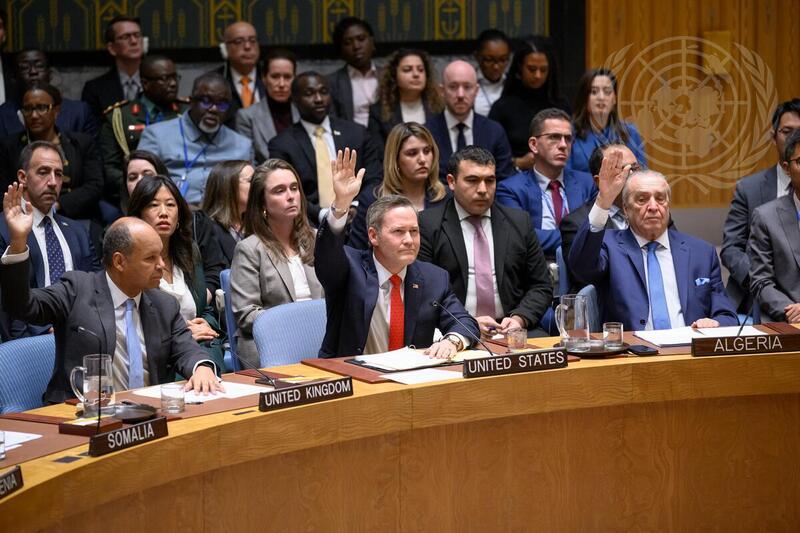
Despite the abstentions from the Russian Federation and China, the United Nations Security Council has voted in favor of a U.S backed Gaza resolution, Resolution 2803.

United Nations
Sphinx News: Ahmed Ali
On Monday, November 17th, the United Nations Security Council passed a United States backed draft resolution on Gaza. Now Resolution 2803, the resolution was presented by United States Ambassador to the United Nations, Mike Waltz, but had the diplomatic backing of several states of the Middle East which have served as important mediators in the contentious affairs between Israel and Hamas. These states are: Qatar, Egypt, Turkiye, Jordan, and Saudi Arabia.
With the plan outlying further steps on what Ambassador Waltz puts a, “comprehensive plan to end the Gaza conflict”, the resolution endorsed continued humanitarian aid into the decrypt Gaza Strip, and additionally established and diplomatically fortified two political mechanisms as formerly mentioned in Trump’s agreed upon, 20 point Gaza Peace Plan.
The two points are as follows: the establishment of the Gaza Board of Peace to be headed by United States President, Donald Trump, alongside the heavily debated International Stabilization Force in Gaza. Furthermore, the draft text laid out that once the International Stabilization Force is established, the Israel Defense Forces will withdraw from the Gaza Strip based on standards, milestones and timeframes linked to demilitarization. The eventual plan of Israel demilitarizing from Gaza will need to be agreed upon by specified parties, conditional under the pretense of maintaining a, “security perimeter presence that will remain until Gaza, and is properly secure from any resurgent terror threat”.
In his comments before the voting commenced, Ambassador Mike Waltz stated that the draft text is, “no mere paper promise, but a lifeline”. The stabilization force he explained will be mandated to secure Gaza’s streets, oversee demilitarization, protect civilians and escort aid through safe corridors — all while Israel phases out its presence and a vetted Palestinian police force takes on a new role.” Waltz stressed that, “the time to act is now”, urging Council Members to support the draft text as its diplomatic backing is integral, he added, to the, “future of Gaza and its children.”
Once voted on, the Security Council passed the Resolution, now Resolution 2803. The draft text had 13 Council Members vote in favor, with only two abstensions. The two abstentions were both from Permanent Security Council Members, Russia and China. Despite their contention and worry about the situation as demonstrated with their later comments and reluctance to vote in favor, their decisions to abstain as opposed to vote to block, saw the resolution’s adoption.
In explanations of why they voted to abstain, both Russia and China felt that the contents of the draft text were insufficient. In their comments, they brought up concerns such as: extra unintended mandates for the ISF (International Stabilization Force), ambiguous language on a two state solution, and a clear lack of peacekeeping role for the United Nations.
In his comments after the voting, Permanent Representative of the Russian Federation to the United Nations, Vassily Nebenzia said, “This is a draft that we simply could not support.” He added that the Russian Federation appreciates the efforts by the United States and mediators to “halt this hot phase of the Israeli Palestine conflict”, but ultimately the resolution fails, he added, to reaffirm the fundamental decision and cornerstone of the Council’s majority attitude towards the situation to “adopt a formula of two States for two peoples.” Nebenzia highlighted that the resolution is vague and obsolete in its language for a two state solution, mentioning that the Israeli Government have made, “unequivocal public statements … asserting that creating a Palestinian State is nothing but unacceptable.” The United States Resolution he added echoes this notion, with what he deems to be, “a lack of clarity in the draft regarding the timelines for the transfer of control over Gaza to the Palestinian Authority (PA), nor any certainty vis-à-vis the Board of Peace and the International Stabilization Force (ISF), which, judging by the text of the resolution adopted today by the Council, will be able to act absolutely autonomously, without any regard for Ramallah’s (Palestinian Authority in the West Bank’s) position and opinion.”
Questioning the role of its intended peacekeeping nature, Nebenzia would also raise questions on the mandate of the ISF, within the adopted draft text. The Russian Ambassador makes abundantly clear that when Trump’s Gaza Peace Plan was first proposed, the ISF’s mandate was not specified as, “demilitarizing Gaza nor disarming local armed groups.” The resolution however, he says, “ confers on the ISF such extensive peace enforcement mandate that the mission may actually transform into a party to the conflict going beyond the confines of peacekeeping.
China ultimately echoed this Russian sentiment, with the Chinese Representative to the United Nations, Fu Cong saying the text was “vague and unclear” on critical elements such as the structure, composition and terms of reference for both the Board and the Force and ISF. Cong would also add that the resolution had little mention of both Palestine to, “effectively participate” in the solution, and the United Nations, seeing as it has “ample experience” in the realm of peacekeeping.
Nonetheless, at a press stakeout after the Security Council adopted the text as Resolution 2803, Waltz and his team welcomed the overall vote in favor as a, “truly a historic moment at the United Nations.” Passing the resolution he added, “proved the United Nations can be great again, proved the United Nations can be a beacon for peace, not just a bystander.”
In his remarks and immediate reaction, Secretary General of the United Nations, Antonio Guterres, welcomed the adoption as, “an important step in the consolidation of the ceasefire, which the Secretary-General encourages all parties to abide by.” He adds that building on this diplomatic momentum is “essential”, and now we need “concrete and urgent steps on the ground” to build for the next phase.