Emergency U.N. Security Council meeting sees sharp exchanges between U.S./Israel and Iran
As the United States and Israel launch a military operation against the Islamic Republic of Iran, delegates clash at the Security Council. The now three day war continues to wreak havoc across the Middle East.

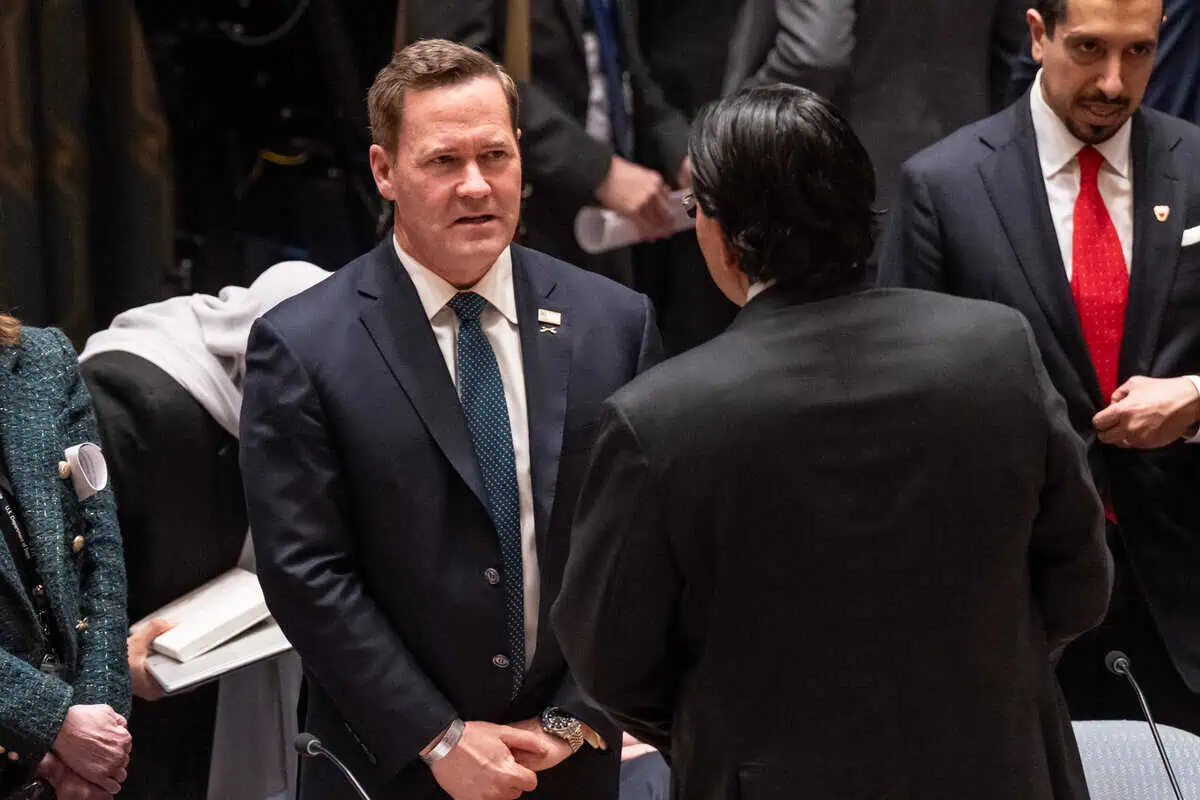
The U.S. Ambassador to the United Nations, Mike Waltz, insisted that the military actions of both the United States and Israel were propagated on a legitimate legal basis, aiming to deter the Islamic Republic’s purported “regional tyranny” and illicit “nuclear program.”
Mentioned as “Operation Rising Fury,” the military incursion, he added, was directed toward “specific and strategic” objectives, particularly: debilitating the government’s missile capabilities, which “threaten allies”; degrading naval assets, which Waltz contends have been used to “destabilize international waters” like the Strait of Hormuz; and eroding the capabilities of a government that “continues to arm proxy militias.” On the latter, Waltz denounced the Iranian government’s “funding to groups including the Houthis, Hezbollah, and Hamas, which have brought bloodshed and disorder across the Middle East for far too long.”
Waltz notes such actions enable both the U.S. and Israel to “ensure that the Iranian regime can never, ever threaten the world with a nuclear weapon.” The U.S. representative also suggested the supposed futility of the ongoing diplomatic negotiations, positing that in their discussions “Iran has refused to abandon both its nuclear ambitions,” and continued to “enrich large uranium stockpiles.”
Equally polemical in their rhetorical appeals, the Israel delegation and its Permanent Representative, Danny Danon, stated, “Today, alongside the United States, Israel acted to stop an existential threat before it became irreversible.”
Danon adamantly appealed to the Council that the incumbent Iranian administration has supported what he called “a state-sanctioned hatred.”
He added that the government has encouraged the chanting of “death to America and death to Israel,” further insisting that such divisive appeals have equally been coupled with “large uranium stockpiles” and “underground missiles and military facilities.”
The decision to act was therefore “out of necessity” because “the regime left no reasonable alternative.”
Where “diplomacy has been exhausted,” conducting the joint military operation with the United States, he says, is an attempt to debilitate a “regime” that has “built nuclear weapons, murdered its own citizens, crushed dissent, expanded missile arsenals, armed proxies across the region, and declared its intention to erase Israel from the map.”
The supposedly preemptive nature of the military operations was denounced by the Iranian Representative, Ambassador Amir Saeid Iravani, as “a war against the UN Charter” and one that continues to undermine the legitimacy of the “international legal order upon which the United Nations was built eight decades ago.”
Ambassador Iravani added that such blatant measures of aggression “satisfy none of the criteria for lawful self-defense.” Therefore, Ambassador Iravani evoked his country’s right to self-defense under Article 51 of the United Nations Charter. Such measures, he added, are aimed at preserving the territorial integrity and sovereignty of the Islamic Republic, while subsequently conducting “a decisive response without any hesitation.”
Firmly committed to “respecting the territorial integrity and sovereignty of our neighbors,” Ambassador Iravani suggested retaliatory attacks have not been aimed at harming civilians or civilian infrastructure, but at U.S. military bases in the region, coupled with strikes directly aimed at Israel.
Conversely, the strikes “devoid of any reasonable legal foundation” by the United States and Israel, according to Ambassador Iravani, “have deliberately attacked civilian-populated areas in multiple large cities.” He noted, “This is not only an act of aggression; it is a war crime and a crime against humanity.”
In attempts to legitimize its brazen actions, Ambassador Iravani highlighted that “the United States has attempted to distort facts and rely on misinformation.”
On his final note, Ambassador Iravani detested notions aimed at delegitimizing Tehran’s “peaceful nuclear program,” asserting equally that these so-called “preemptive attacks” have deteriorated Tehran and Washington’s nascent diplomatic negotiations.
In a rare verbal exchange, Ambassador Iravani and Ambassador Waltz traded warnings and direct rebuffs toward the end of the emergency session.
After Waltz responded to Iranian claims that the U.S. had violated international law, Iravani asked to speak again, stating, “I advise the representative of the United States to be polite. It will be better for yourself and the country you represent.”
Ambassador Waltz responded immediately, saying, “This representative sits here, in this body, representing a regime that has killed tens of thousands of its own people and imprisoned many more simply for wanting freedom from your entire tyranny.”
Latest Developments
Meanwhile, the situation continues to escalate on the ground. Reports suggest that joint U.S.-Israeli attacks have killed at least 555 people, with the Iranian Red Crescent Society saying more than 130 cities across the country have come under attack. In Israel, 11 people have been killed, with 31 in Lebanon, according to authorities.
Today, U.S. Secretary of State Marco Rubio briefed reporters on Capitol Hill in Washington, D.C. Rubio told reporters that the Iranians “have been building a weapons potential capacity as a shield that they can hide behind.” The intention, he added, “was to put themselves in a state of immunity so they could inflict more damage across the region with their ballistic missiles and nuclear capabilities.”
With regard to U.S. ground troops, Rubio contended that the United States is not postured for ground forces in Iran at this moment, but President Donald Trump has those options. The objective, he added, can be achieved without ground troops, where the “hardest hits are yet to come.”
In letters to the UN Secretary-General and the president of the UN Security Council, Qatar has condemned Iran’s attacks on its territory and against other Gulf nations, calling them “an unacceptable escalation that threatens the security and stability of the region.”
The letters, by Sheikha Alia Ahmed bin Saif Al Thani, Qatar’s ambassador to the UN, also said that the country reserved the right to respond to the attacks.
She detailed how, on Saturday, after U.S. and Israeli strikes killed Iranian Supreme Leader Ayatollah Ali Khamenei, Iran fired 83 missiles and 12 drones at Qatar.
Qatar was able to intercept 81 of those missiles and 11 of the drones, but two missiles slipped through and hit the Al Udeid airbase, where U.S. forces are stationed. One drone managed to strike an early warning system. However, there were no casualties from these events.
According to Iranian state media, a commander in Iran’s Revolutionary Guard says the Strait of Hormuz is now closed and warned any vessel attempting to pass through will be attacked. The Strait of Hormuz, which lies between Iran and Oman, is one of the world’s most critical oil transit routes, with roughly 20 percent of global oil supplies passing through it.
“The strait is closed. If anyone tries to pass, the heroes of the Revolutionary Guard and the regular navy will set those ships ablaze,” said Ebrahim Jabari, a senior adviser to the paramilitary force’s commander-in-chief.
While Tehran continues to launch military strikes across the region, Foreign Minister Abbas Araghchi says Iran is “not at war with regional countries” but it is with the United States after the country was attacked on Saturday.
“We’re not attacking our neighbours; we’re attacking U.S. military bases,” he told state media. “U.S. soldiers fleeing to hotels will not prevent them from being targeted.”
Consequently, the initial strikes launched on Saturday have provoked responses from the Lebanese group, Hezbollah.
Hezbollah, launching attacks on Israeli soil for the first time in a year and responding to the announced death of Iranian Supreme Leader Ayatollah Khamenei, fired a barrage of missiles and drones toward an Israeli military site in the northern city of Haifa. In response, Israel attacked Dahiyeh, Beirut’s southern suburbs, where at least 52 people have been killed and mass displacement continues to loom.