UN Absent From Critical Middle East Meeting in Doha
As the United States and Iran are set to hold critical talks tomorrow in Doha, Qatar, UN's presence remains missing

United Nations, New York City
Sphinx News: Ahmed Ali
As U.S. President Donald Trump announces a pivotal meeting with Tehran in Qatar aimed at preserving the fragile regional ceasefire, the United Nations remains absent, raising questions about the organization’s role in, or capacity to participate in, critical diplomatic negotiations.
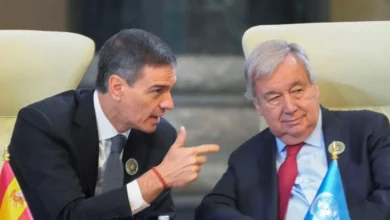
The omission from the crucial meeting was officially announced today by Stéphane Dujarric, Spokesman for the Secretary-General. Dujarric told Sphinx TV that the Personal Envoy for the Secretary-General on the Middle East, Jean Arnault, would not be participating in Doha tomorrow.
Since the conflict officially surged in late February, Jean Arnault has been dispatched by the United Nations to multiple states in the Middle East, including Iran, Saudi Arabia, Oman, and Türkiye. While the details of such discussions have remained discreet, reports indicate that Jean Arnault has received “positive feedback”, along with peace contentions reciprocal to that of the United Nations’ initiatives within the region.
However, the latest exclusion has revealed an underlying pattern that many critics of the UN apparatus have been quick to raise: the UN, intended to be a key arbiter of contemporary global peace, integrative discussion, and conflict resolution, remains excluded from yet another high-level intergovernmental meeting, purportedly riddled with, as previously stated by U.S. Secretary of State Marco Rubio, “uselessness.”
Most notably, with reference to more recent international negotiations and strategic forums, the United Nations has not been involved in the U.S.-led Board of Peace initiative between Israel and the Occupied Palestinian Territory, U.S.-Iran nuclear mediation (largely facilitated by both Oman and Pakistan), and the Quad Plan (a diplomatic framework laden with flaws, established by the United States, Egypt, Saudi Arabia, and the UAE, aimed at resolving the Sudanese Civil War).
While certain initiatives have been supplanted by United Nations assurances, such as the implementation of Security Council Resolution 2803, establishing the U.S.-led Board of Peace initiative as a sustainable framework for lasting relations between the Israelis and the Palestinians, UN involvement has been few and far between.
Spearheading the United Nations’ obituary has been the United States, specifically, U.S. President Donald Trump. Speaking to high-level delegates at UNGA80, the United Nations 80th Annual Session of the General Assembly held in September 2025, Trump underscored the “potential” of the organization, lambasting its ability to effectively broker significant peace deals. “Instead,” he told the Assembly, the organization produces “strongly worded letters.”
Concurrent with its objections to the United Nations’ vitality and practical relevance, early this year, the United States announced its formal withdrawal from 31 relevant UN agencies, halting all associated funding to agencies like the UN Population Fund, Department of Economic and Social Affairs, UN Energy, and many more.