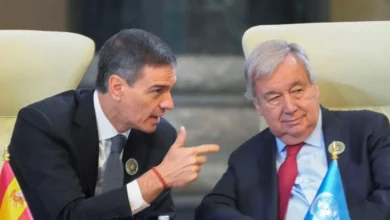
Secretary-General Addresses Security Council Open Debate on the Middle East
Presided over by Colombian President Gustavo Petro Urrego, the Security Council convened an open debate on the Middle East, during which Secretary-General António Guterres reiterated his calls for diplomacy.

United Nations, New York
Sphinx News: Ahmed Ali
Under the Presidency of Colombia, chaired by its head of state, Gustavo Petro Urrego, the Security Council deliberated on the Middle East, discussing the Iran war, the ongoing devastation of Gaza, settler violence in the occupied West Bank, the crisis in Lebanon, and the prolonged arbitrary detention of UN personnel in Yemen.
The wider instability of the Middle East has been catalyzed by insularity, perpetual violence, and unwavering diplomatic negotiations, all inextricably contributing to the stalling of sustainable peace.
Echoing these sentiments was UN Secretary-General António Guterres, who condemned the region’s current developments and hostilities as having lasting global implications. While the Middle East’s lasting destabilization has often been set aside by non-regional actors, Guterres’s retributions vehemently insist that the region’s chaos is creating pernicious aftereffects, devastations that ought to be recognized and averted as soon as possible.
“The Middle East is being pulled deeper into crisis,” he says, citing a surplus of conflicts within the region that have stifled the viability of international diplomacy, and with that, the benevolence and credibility of the United Nations.
Addressing the “dramatic events in Lebanon,” where hostilities between Hezbollah and Israel have pervaded throughout the entirety of the country’s southern territory, Guterres notes that we have seen “the forced displacement of over a million civilians,” coupled with the “extensive demolition of homes and civilian infrastructure.”
Highlighted by the “killing of seven UN peacekeepers – including one last week,” the conflict’s inherently indiscriminate nature has thwarted prospects for a conducive “diplomatic settlement.” With that, Guterres calls for the unequivocal respect for Security Council Resolution 1701, authorizing a comprehensive ceasefire between both sides, the mandate of peacekeeping forces, and the territorial integrity and sovereignty of Lebanon under the jurisdiction of the Lebanese Government and its Armed Forces.
While the Secretary-General’s staunch stance on Lebanon echoes that of the international community, purportedly righteous in its denunciation of Israeli belligerence, it is the Secretary-General’s statement on the United States that raises concern. On the Lebanese conflict, Guterres told Council members, “I commend the United States for facilitating talks between Israel and Lebanon,” a statement that seemingly neglects Washington’s initial involvement in the renewal of hostilities between both parties.
While tensions between Hezbollah and Israel remained contentious after the ceasefire of November 2024, it was Tel Aviv and Washington’s attack on Tehran in March 2026 that reignited the latest wave of large-scale violence between both sides. Following the death of Iranian Supreme Leader Ayatollah Khamenei, assassinated in a dual strike launched by both Israel and the United States, Hezbollah attacked Israel. In a statement released by Hezbollah on March 2nd, the Lebanese group stated its assault was “revenge for the martyrdom of Ayatollah Khamenei and to defend Lebanon and its people against repeated Israeli aggression.”
Guterres later dedicated part of his protestations to discussing the ongoing conflict between Israel and the Palestinian people. On Gaza, the besieged enclave still faces “profound uncertainty and immense human suffering,” compounded by the deprived access to “clean water, sanitation, food, shelter, health care,” and other resources for the Palestinians of Gaza.
Accelerating the already perilous conflict is Israel’s prolonged occupation of Gaza, a direct violation of Security Council Resolution 2803, endorsing the “Comprehensive Plan facilitated by the United States, Qatar, Egypt, and Türkiye” as a political solution. Guterres notes with firm rejection and dismay the “Israeli government’s recent decision to control 70 percent of the strip,” contending that such a development inhibits peace, “fuels extremism,” and plunges the “region further into apartheid.”
The continued position of both U.S. and Israeli officials, coated in erroneous subtext, has been clear: the Comprehensive Plan of Action cannot be formally implemented until Hamas is fully disarmed. The contentious notion was spotlighted by Washington’s appointed high representative of the Board of Peace, Nickolay Mladenov.
Addressing the Security Council on May 21st, Mladenov, a veteran Bulgarian diplomat, told the Council the main obstacle to full implementation of the ceasefire remains “Hamas’ refusal to accept verified decommissioning, relinquish coercive control, and permit a genuine civilian transition in Gaza.”
Methodical in its implications, such a statement dismisses the genuine plight of the Palestinian people, evading the predominant view that the primary aversion to peace is not Hamas, but the Israeli authorities.
On the West Bank, Guterres notes alarming reports of “the demolition of homes, destruction of farms, and confiscation of land,” all a part of the “relentless expansion of illegal Israeli settlements.” Guterres characterizes such developments, recently institutionalized by Israel’s primary congressional body, as “attempted annexation” with “no legal validity.”
In Syria, Guterres spoke of a fragile state, one requiring continued international assistance to rekindle a country deprived of peace and political stability. “We cannot let progress be jeopardized by further use of force or wider regional instability,” he says.
On Yemen, Guterres urged the de facto Houthi authorities to “release all arbitrarily detained UN personnel – as well as those from NGOs, civil society and diplomatic missions.”