5 countries elected for 2027 Security Council term; Germnay faces narrow loss
Austria, Kyrgyzstan, Portugal, Trinidad and Tobago, and Zimbabwe are elected to the 15-member council for two-year terms starting on January 1, 2027

United Nations, New York City
Sphinx News: Ahmed Ali
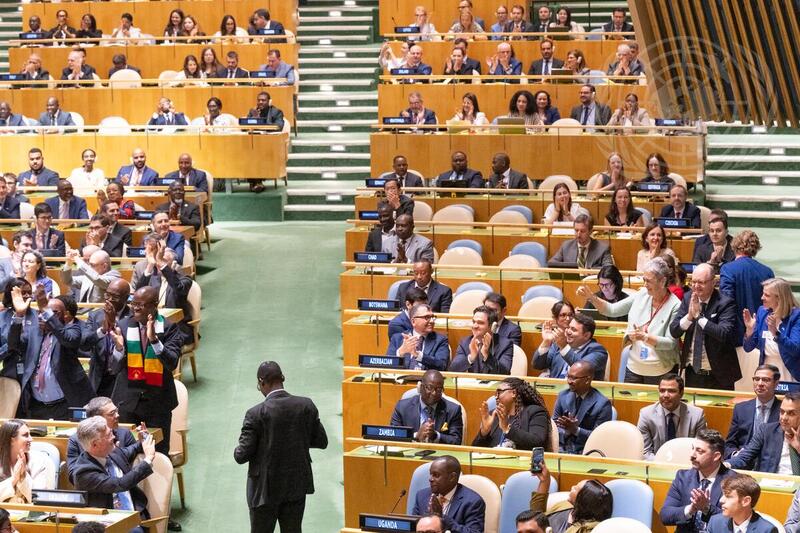
Today, the United Nations General Assembly held a decisive vote to elect 5 non-permanent members of the Security Council, ultimately choosing Austria, Kyrgyzstan, Portugal, Trinidad and Tobago, and Zimbabwe for two-year terms starting on January 1st, 2027.
The Security Council is a 15-member body, pivotal as the only UN body with the authority to adopt legally binding decisions, impose sanctions, deploy peacekeeping forces, and authorize the use of force. Of the 15-member Council, 5 member states are Permanent Members, holding decisive veto power in times of critical voting procedures. The 5 permanent members are the United States, the People’s Republic of China, the Russian Federation, the United Kingdom, and France. The remaining 10 members are subject to constant rotation, serving two-year terms. Of the 10 non-permanent members, this latest voting cycle replaced 5 of them: Somalia, Panama, Denmark, Greece, and Pakistan.
As voted by member states, Zimbabwe replaced Somalia as the member state hailing from the African Group, Trinidad and Tobago replaced Panama as the member state of the Latin American/Caribbean region, Portugal and Austria will replace Denmark and Greece as member states of Western Europe, and Kyrgyzstan will replace Pakistan as a member of the Asia-Pacific Group. The remaining 5 non-permanent member states, Bahrain, Colombia, Democratic Republic of the Congo, Latvia, and Liberia, will finish the remaining 1 year of their two-year term.
The voting, however, was anything but straightforward, with European powerhouse Germany, lobbying hard for a seat, coming third for the two places contested by Western Europe. Germany received 104 votes, against 134 for Portugal and 131 for Austria.
Beate Meinl-Reisinger, Foreign Minister of Austria, spoke to the General Assembly after her country won one of the two decisive Western European seats. Reisinger told members of the press that Austria intends to “take this responsibility very seriously,” aimed at facilitating multilateral diplomacy through a very polarized Security Council.
Paulo Rangel, the Foreign Minister of Portugal, also addressed the press following the conclusion of the voting, expressing Portugal’s gratitude and vowing to fulfill its mandate as a member of the Security Council. Receiving the most votes out of any of the five states, Rangel said that such an occurrence is indicative of Portugal’s “external reputation for upholding multilateral diplomacy,” a state, he says, which has always “upheld the sanctity of the UN Charter.”
Foreign Minister of Germany, Johann Wadephul, told members of the press that Germany, while not being elected for the upcoming term, is “confident that its Western European counterparts (Portugal and Austria) will work for the benefit of the global community, and for peace and security.” While “Germany too was ready to contribute substantially to the work of the Security Council for the next two years,” Berlin will still be “working with all member states to strengthen global security.” Wadephul added that the result is “a real disappointment, and a bitter defeat,” having presented a “good offer on the table.”
What was even more contested, however, was the vote between the Philippines and Kyrgyzstan for the Asia-Pacific Group. The vote between the two member states went to four rounds, with Kyrgyzstan eventually achieving the necessary two-thirds majority and securing its first-ever Security Council seat by 142 votes to 49.