UN Delivers 2026 SDG Report: A Disproportinate Future
UN Report Outlines Progress and Peril in 2026 Sustainable Development Goals

United Nations, New York City
Sphinx News: Ahmed Ali
Officially launched in 2015, the United Nations, under the incumbent Secretary-General, António Guterres, adopted 17 Sustainable Development Goals (SDGs), initiatives aimed at assessing and mapping tangible progress across a variety of political, social, and economic disciplines.
Entering its eleventh year of tangible efforts, signified by an annual record, this year’s 2026 SDG report highlights the international system’s glaring economic inequality, conflict, and social stagnation.
While certain issues like climate change have hinted at remarkable improvements, meaningful evidence that positive changes are possible under existing political and social grievances, issues of poverty, hunger, quality education, gender equality, and economic growth suggest that regression will continue to characterize much of the planet’s issues.
The report perpetuates a theme of looming inequality, emblematic of socio-political and economic conditions inculcated throughout most of the underdeveloped world. Such a fact is noticeable in the report’s aggregate “progress,” where it states, “Most regions will be close to eradicating extreme poverty by 2030, except sub-Saharan Africa, the Middle East and North Africa, and Oceania (excluding Australia and New Zealand).”
Additionally, data suggests that “global unemployment stood at a near-historic low of 4.9 percent in 2025.” Amid the ostensible progress, however, such facts become glaringly obvious, particularly in the ongoing peril facing both the MENA (Middle East and North Africa) region and nearly all of Africa.
As the report explains, conflict-ridden zones become particularly liable to disparaging conditions, hotspots that trigger immediate or onerous decay in essential governance, infrastructure, economy, and already fragile social relations. Conflict lays impetus to the destruction of state enterprises, creating environments praised for resilience but suffering from internal failure. Regression is not linear; rather, as reflected within the report, it is a social phenomenon that is inextricably associated with all essential facets of society.
An inability to foster comprehensive social and political institutions creates disjunction, encouraging violence, gender inequity, poverty, economic injustice, debilitating industrial progress, and so on.
“273 million children and young people remain out of school; one in five young people aged 15-24 are not employed, educated, or training, and young people are nearly four times more likely to be unemployed adults,” reads the report.
“Violent conflict has surged to its highest level in decades. As of December 2025, more than 117.8 million people were forcibly displaced worldwide, erasing years of development gains in months.”
Such an alarming setback is engraved in nearly all the 17 SDGs, noted by Deputy Secretary-General Amina Mohammed as “serious gaps” in the 17 SDGs’ effectiveness.
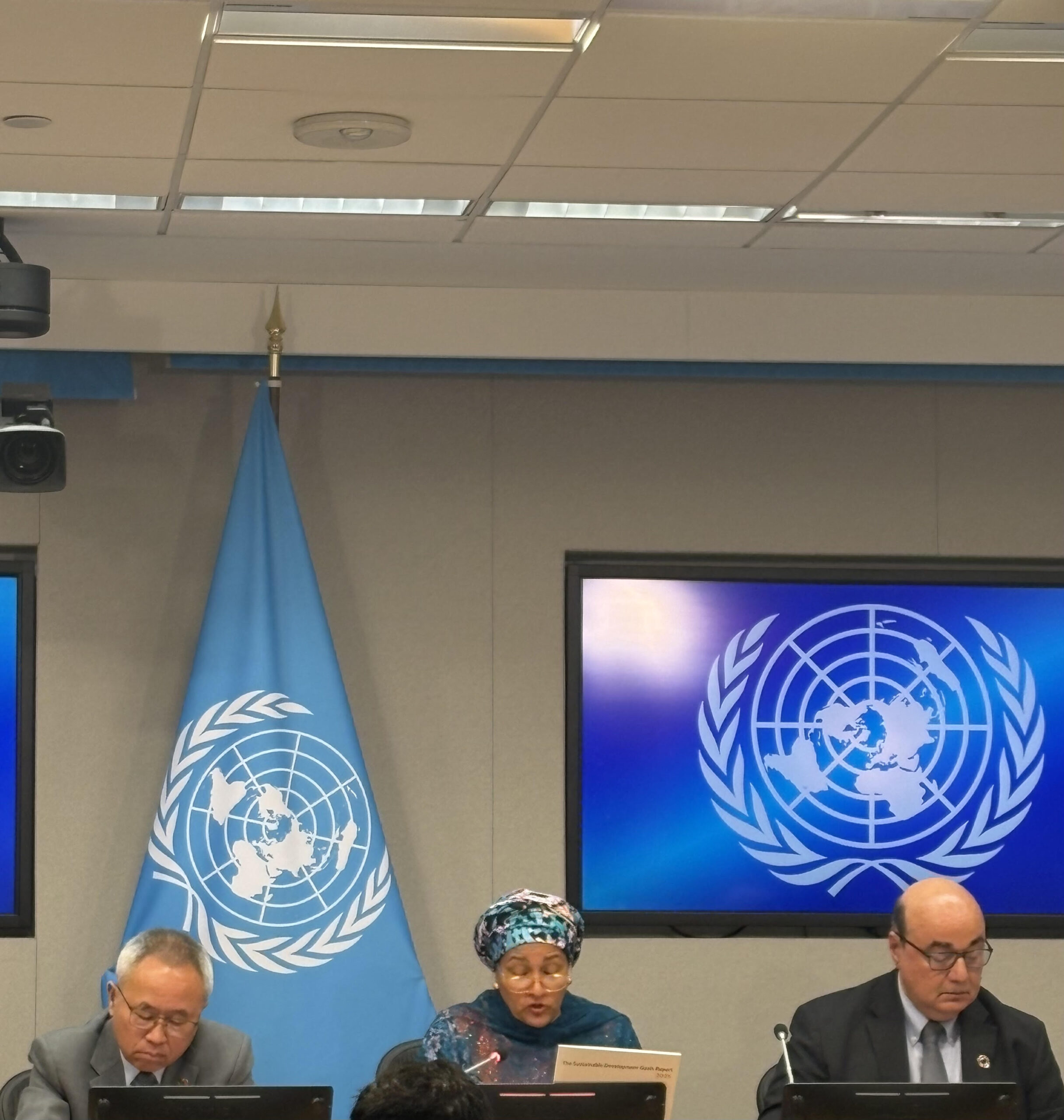
Introducing the findings of the report, sitting alongside Li Junhua, Under-Secretary-General for Economic and Social Affairs, and Shantanu Mukherjee, Acting Director, Statistics Division, Department of Economic and Social Affairs, Deputy Secretary-General Mohammed told the press, “Today, thanks to these findings, we can say two things with confidence: that the sustainable agenda, its 17 goals, work, just not fast enough, not evenly and more inclusively, and there are huge risks of reversals.”
Beginning with the goal of “no poverty,” the report contends that 1 in 10 people live in absolute poverty, a development which, according to existing trends and relevant data, is “not likely to change by 2030.” While government-led social protection coverage has “reached more than half the global population,” 3.8 billion people remain unprotected, a development prevalent within the MENA, Sub-Saharan Africa, Latin America, and both Central and South Asia.
On the goal of “zero hunger,” the report exhibits improvement in child nutrition and agricultural productivity in some areas, yet major discrepancies in others. Since “2024,” the report says, “2.3 billion people—28 percent of humanity—faced moderate or severe food insecurity, meaning they lacked regular access to adequate food at some point in the year.” The latest trade disruptions in the Strait of Hormuz have exacerbated this issue, increasing the price of essential fertilizers, natural gas, and fuels, resources which are crucial to food production.
On the goal of “quality education,” 273 million children still lack access to education. Access to basic school infrastructure has not risen consistently, rising in Central and Southern Asia by over 15 percent since 2015, yet remaining stagnant in both Sub-Saharan Africa and the MENA. Overall, “more than one fifth of primary schools still lack access to electricity, safe drinking water, or basic sanitation, while fewer than half have computers, internet access, or disability-adapted infrastructure.”
Despite the goal of “gender equality,” gender-related violence continues to spread throughout conflict zones, indicating unequal conditions across different regions of the world. While women’s leadership in government has slightly improved since 2015, holding “27.4% of parliamentary seats and 35.6% of local government positions,” it is still reported that “nearly one in five girls still marry before the age of 18,” an alarming statistic that reinforces unequal power dynamics, non-self-sufficiency, misogyny, and unequal access to the workforce.
On the goal of “decent work and economic growth,” statistics continue to signify disproportionate growth. While global unemployment suggests a historic low of 4.9%, “one in five young people, between the ages of 18-24, are not employed, nor in formal education/training.” Additionally, while not mentioned in the report, many of those employed continue to suffer from a low quality of life, unable to access more steady, growing economic opportunities.
The remaining reports of the SDG goals continue to prove an unequivocal fact: development is not consistent, yet development is possible.
“The task now,” said Li Junhua, United Nations Under-Secretary-General for Economic and Social Affairs, “is to scale up what works—with the urgency, investment, and cooperation needed to fulfill the promise of the 2030 Agenda.”
More importantly, an immediate improvement will be seen upon the reduction of global hostilities, a call made by Deputy Secretary-General Amina Mohammed that urges governments to return to the negotiating table, reduce military spending, and invest in sustainable peace.